Coffee Tables · 24 min read
How to Choose a Coffee Table: The Complete Buyer's Guide
 Donald Martin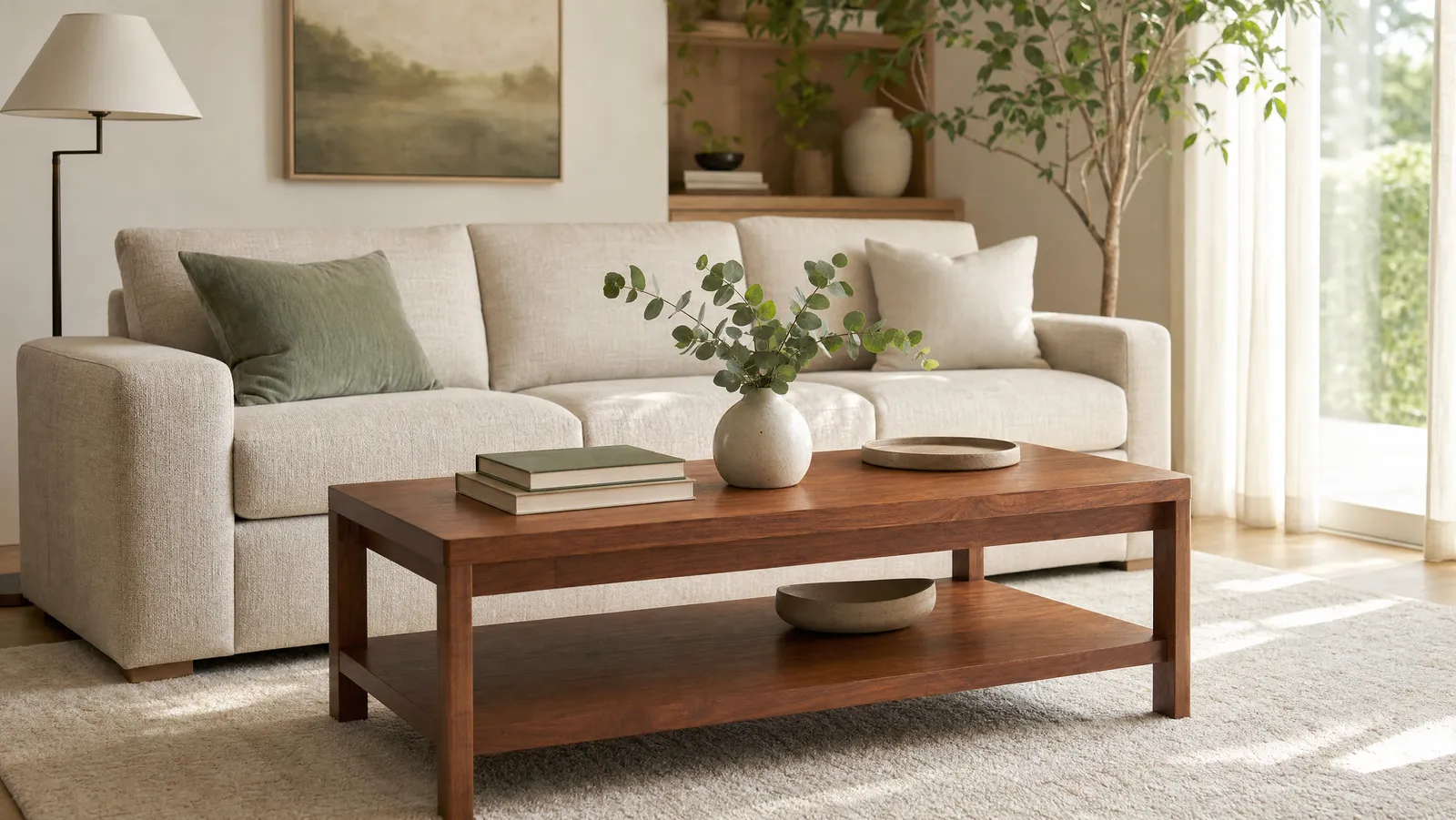
Buy a coffee table 16 to 18 inches tall, roughly two-thirds the length of your sofa, and leave 14 to 18 inches of open floor between the sofa's front edge and the table's near edge. Those three numbers decide whether a room works. Shape, material and storage are preference; the measurements are not.
Some links below are affiliate links; if you buy through them we may earn a small commission at no extra cost to you.
Most people shop for a coffee table the way they shop for art — by picture, at a distance, with no tape measure in the room. That is why so many living rooms end up with a table you have to shuffle sideways past, or one that looks like a footstool next to a deep sectional. This guide covers how to choose a coffee table in the order the decision actually happens: size first, then shape, then material, then the details that only matter once the thing is in your living room. At the end we name the six tables we would buy, and what each one is for.
How to Size a Coffee Table for Your Room
Three measurements. Take them in this order.
Height: match the sofa seat, or go an inch or two lower. Sit on your sofa the way you normally sit, then measure from the floor to the top of the compressed cushion — not the uncompressed cushion, which can be two inches taller. Keck Furniture's coffee table sizing guide puts the rule plainly: the table should be level with the sofa seat cushion height or 1 to 2 inches lower, and notes that tables generally run 14 to 20 inches tall. Wayfair's coffee table size guide narrows the practical band further, recommending 16 to 18 inches so the table stays within easy reach and does not block the view across the room. A table taller than the seat makes you lift a drink over the edge; a table much lower makes you lean.
Length: about two thirds of the sofa. Both guides land on the same fraction. Keck recommends choosing a table roughly two thirds the length of your sofa, and Wayfair states the same proportion. Run the arithmetic on your actual sofa rather than a category: a 72 inch loveseat wants a table near 48 inches, an 84 inch sofa wants something in the mid-fifties, and a 96 inch sofa can carry a 60 inch table or two smaller pieces side by side. Undersizing is the more common error, and it is the one that makes an expensive room look unfinished.
Clearance: 14 to 18 inches to the sofa. RoomSketch3D's furniture clearance standards specify 14 to 18 inches between sofa and coffee table. Keck describes about 18 inches as the comfortable reach zone. Go tighter than 14 and people bark their shins standing up; go past 18 and you have to lean forward off the cushion to set a glass down, which defeats the point of the table.
Before you buy anything, tape it out. Painter's tape on the floor in the exact footprint, left there for a day, tells you more than any product photo. Walk the room. Sit down and stand up a few times.
The rug is part of this calculation, not separate from it. A coffee table should sit entirely on the rug with room to spare on all sides, which means the rug has to be sized for the whole seating group first — our area rug size guide walks through what each room actually needs. If the rug is already down and the table would straddle its edge, the rug is the problem, not the table.
We go further into unusual room shapes, loveseats and double-table layouts in our complete coffee table size guide, but those three numbers will get you most of the way there.
Choosing a Coffee Table Shape
Shape follows the seating plan, not the room's outline.
- Rectangle. The default, and the right answer for a standard sofa facing a TV or a fireplace. It mirrors the geometry of the sofa, gives you the most usable surface per square foot of floor, and it is the easiest shape to size with the two-thirds rule. Trade-off: four corners at shin height.
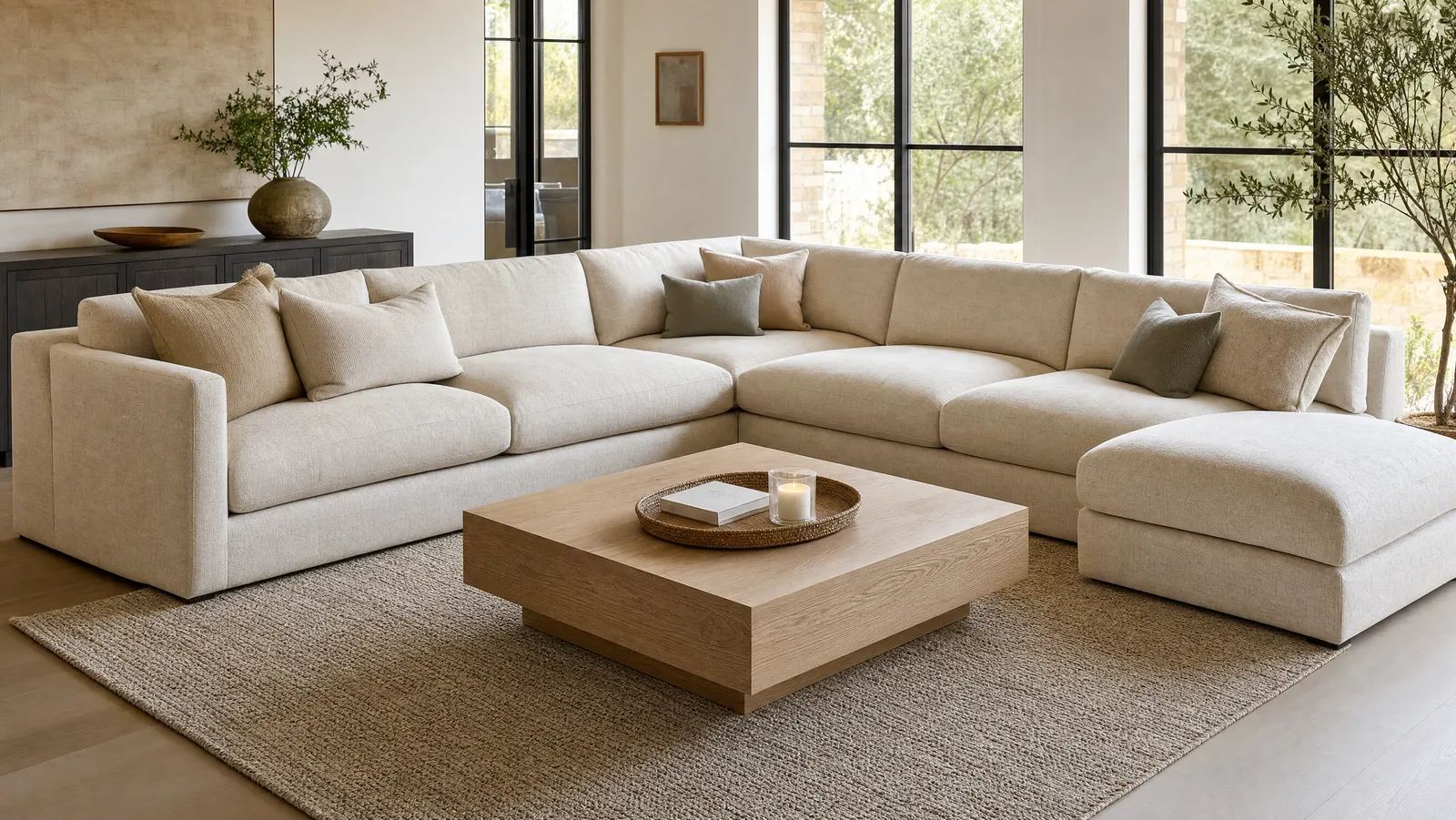
- Square. For sectionals and for conversation layouts where seating comes at the table from three or four sides. Wayfair's size guide puts square tables in the space between U-shaped or L-shaped sectionals, and in larger rooms with clearance for foot traffic — which is exactly the geometry a rectangle fights.
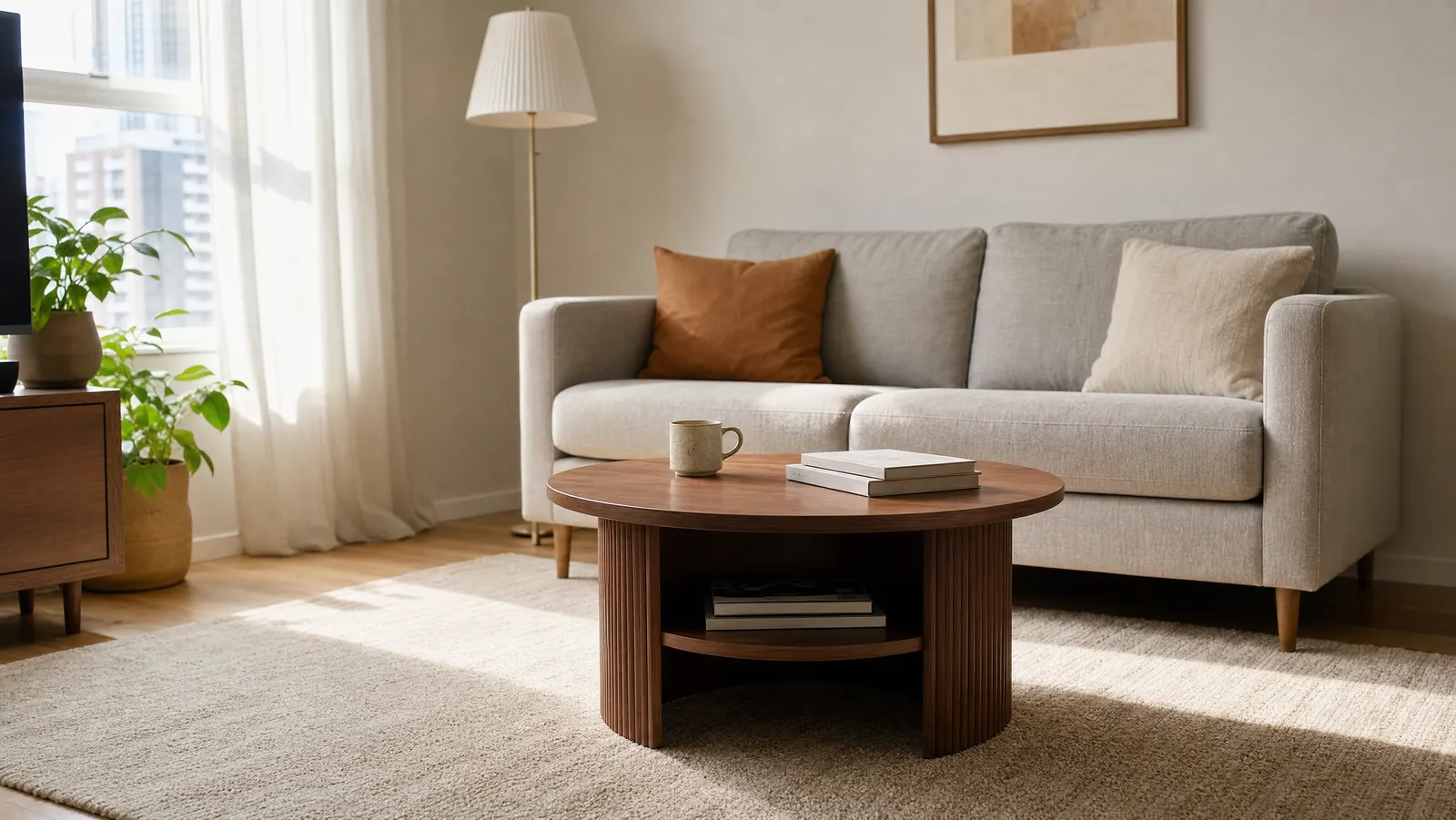
- Round. No corners, and easy to walk around — Wayfair's guide calls round tables ideal for smaller living spaces precisely because they have no sharp corners to maneuver around. This is the shape we recommend in tight rooms, in households with toddlers, and anywhere the table sits in a walking path. Trade-off: a round table loses real surface area against a rectangle of the same overall width.
- Oval. The compromise. Wayfair describes ovals as offering a tabletop shape similar to rectangular designs while their rounded edges make them even more small-space friendly. If you want a long table but the room has a pinch point, this is the shape to look at.
- Two smaller tables or a nesting pair. Two 24 inch pieces pushed together read as one long table and split apart when you need a surface next to a chair. It is the most flexible option and the most fiddly to style.
The honest guidance on how to choose a coffee table shape: if the table sits in front of a normal sofa in a room with normal circulation, buy a rectangle. Buy round when someone has to walk past it, and buy square when a sectional is involved.
Coffee Table Materials Compared
Material determines what the table will look like in ten years, and it is where price differences are real rather than cosmetic.
Solid wood. The long-term answer. In Cedora's comparison of solid wood, veneer and MDF, solid wood is rated for strong long-term value and described as something that can often be refinished, against a higher upfront cost and greater weight. The caveat Cedora names is real: solid timber can move with humidity, so a wide solid top in a dry winter house may show seasonal gaps. Hardwood — oak, maple, walnut — outperforms softwoods like pine for dent resistance, though pine's dings become part of the look on a distressed finish.
Veneer over MDF or plywood. The volume category, and not automatically a compromise. Cedora describes veneer as often more stable on wide surfaces than solid wood and more accessible on price, with limited refinishing compared with solid wood. The failure mode to know: MDF is a weak point with water exposure and is hard to repair once damaged. On a coffee table — a surface that meets sweating glasses every day — that matters. Use coasters, and wipe spills before they sit.
Tempered glass. Visually the lightest option and the reason glass works in small rooms. It also carries the one genuine safety consideration in this guide. The CPSC's tempered glass safety alert states that a voluntary ASTM standard requires tempered glass be used when glass is the horizontal surface of desks and tables, intended to minimize the likelihood of serious cutting and piercing injuries and fatalities from breakage of glass used as a horizontal surface in coffee, dining, end and other tables. The same alert reports that in 2016 an estimated 20,700 injuries associated with glass tables were seen in emergency departments, and explains that spontaneous breakage can be caused by scratches, installation error or other factors because the surface of tempered glass is under pressure. Properly tempered glass is designed to fail safely, rupturing into small fragmented pieces rather than large shards. Two practical takeaways: confirm the listing says tempered, and treat chips or scratches on an edge as a reason to replace the top rather than live with it. Recalls do happen — CPSC's own archive includes a 2018 West Elm recall of glass tables over injury risk.
Metal. Almost always a base rather than a top. Powder-coated steel is durable and cheap to make, which is why it dominates the budget end, and an open metal frame is the most effective way to make a table disappear visually.
Stone and marble. Beautiful, heavy, and porous. Marble etches when acid — wine, citrus, tomato — sits on it, and sealing slows that without preventing it. We would buy stone for a formal room and never for a family room.
If you want the side-by-side breakdown with care requirements for each surface, that is our coffee table materials comparison. The short version: solid hardwood if you intend to keep it, veneer if you want the look for less, glass if the room is small, stone only if you are honest about the maintenance.
Styling the Table Once It Arrives
A coffee table is furniture first and a display surface second, and most styling advice forgets the first half.
- Work in odd numbers. Tribesigns' coffee table decorating guide recommends odd groupings because they read more natural and dynamic than even numbers, suggesting 3 items per cluster or 5 on larger tables. Meet and Co's styling guide frames the same idea as three primary visual groupings — one tray, one stack of books, one standalone sculptural piece.
- Start with a tray. Meet and Co describes a tray as the most effective tool for organization, acting as a frame that makes a collection of random objects look like a curated vignette. Tribesigns gets specific about size, recommending a 12 to 18 inch round or rectangular tray that corrals small pieces, protects the finish, and slides away when you need the surface.
- Vary the heights. Both guides describe the same low-medium-high rhythm: a flat layer such as a tray or book stack, a medium element like a candle or box, and one taller piece that breaks the plane. Tribesigns suggests keeping greenery to a 6 to 10 inch arrangement on a standard 16 to 18 inch table so it does not dominate.
- Leave a third of it empty. This is the rule people break. Meet and Co advises leaving at least 30 to 40 percent of the surface empty; Tribesigns puts it as keeping at least a dinner-plate-sized clear area free for snacks or a laptop. If there is nowhere to put a mug down, the styling has failed.
- Buy big books, not small ones. Meet and Co recommends large-format hardcovers measuring at least 10 by 12 inches. Small paperbacks look like clutter from six feet away.
The table is one layer in a stack that includes the rug under it and the sofa behind it, so read the room as a whole — our roundup of stylish living room rugs covers the layer directly underneath. We get deeper into seasonal swaps and vignette formulas in how to style a coffee table.
Coffee Table or Ottoman?
This is a real fork, not a style preference, and the answer depends on what happens in the room.
Buy an ottoman if you put your feet up, you need occasional extra seating, or you have a toddler at forehead-meets-corner height. An upholstered ottoman gives you all three at once, and a hard tray on top gives you a drink surface when you need one. The trade-off is that you cannot set a glass down without the tray, and every spill becomes an upholstery problem rather than a wipe.
Buy a coffee table if you eat, work, play board games or write on the surface, if you want drawers or a shelf, or if the room already has a footstool. Wood and glass shrug off what fabric absorbs.
Buy both if the room is large enough for a table plus a small ottoman tucked underneath or beside a chair. This is the setup we would choose in most family rooms: hard surface for use, soft surface for feet.
If you are leaning ottoman, our guide to stylish ottomans for the bedroom and living room covers sizing, storage versions and the tray question in detail. We put the two side by side, with the cases where each clearly wins, in coffee table vs ottoman.
Tables That Work with a Sectional
Sectionals break the two-thirds rule because there is no single sofa length to take two thirds of.
Keck's guide gives the workaround: apply the two-thirds proportion to the longest seating run that faces the table, and consider a larger square table or two nesting tables instead of a single rectangle. That is the right instinct. A sectional surrounds the table on two sides, so a long rectangle ends up too far from one run and too close to the other.
What we would actually do:
- Measure the longest run, not the whole sectional. An L-shaped piece with a 96 inch run and a 64 inch chaise is a 96 inch sofa for sizing purposes. Two thirds of that is about 64 inches — bigger than most single coffee tables, which is the argument for a square or a pair.
- Go square when the L is tight. A square top keeps the same distance to both runs. A rectangle cannot.
- Keep the chaise end clear. The whole point of a chaise is stretching your legs onto it. A table that runs past the chaise blocks the one thing it is for.
- Measure clearance from the cushion, not the frame. Deep sectionals push the seating surface forward several inches past the frame, so the 14 to 18 inches of clearance has to be measured from where your knees actually land.
- Consider two tables. Two smaller pieces let you serve both runs and slide apart when someone needs floor space.
Our dedicated guide to the best coffee table for a sectional works through L-shapes, U-shapes and chaise orientations with specific dimensions.
Lift-Top Tables for Working and Eating
If you eat dinner or answer email from the sofa, a standard coffee table is the wrong height and no amount of good posture fixes it.
The numbers are stark. Eureka Ergonomic's guide to coffee table height for laptop work recommends a working surface of 22 to 25 inches for casual laptop use, against the 16 to 18 inches a conventional coffee table provides — a gap the guide says forces excessive forward head tilt and strain through the neck and shoulders. Its duration guidance is useful: a standard table is acceptable for sessions of about 15 minutes, while anything approaching two hours calls for a higher surface.
A lift top closes most of that gap. The mechanism raises the surface and, on most designs, slides it toward the sofa, so the laptop or plate comes to you instead of the other way around. Two honest cautions. First, a lift top is not a desk — Eureka's own recommendation is a hybrid approach and regular movement breaks, not eight hours on the couch. Second, a lift mechanism is a moving part in a piece of furniture that otherwise has none, so it is the component most likely to fail, and it adds weight and cost.
The lift-top pick below, the Lift-Top Coffee Table with Storage, measures 52 by 28 by 18 inches in reclaimed solid pine, with storage under the raised top. We compare mechanisms, weight ratings and storage volume in the best lift-top coffee tables.
Tables with Real Storage
There are three kinds of coffee table storage and they are not interchangeable.
Open lower shelf. Cheapest to build and the most common. It doubles your surface area and it displays everything you put there, which is fine for books and baskets and terrible for cables and remotes. The Two-Tier Solid Wood Coffee Table below is this format done well, with a full-width second tier under a 43.3 inch top.
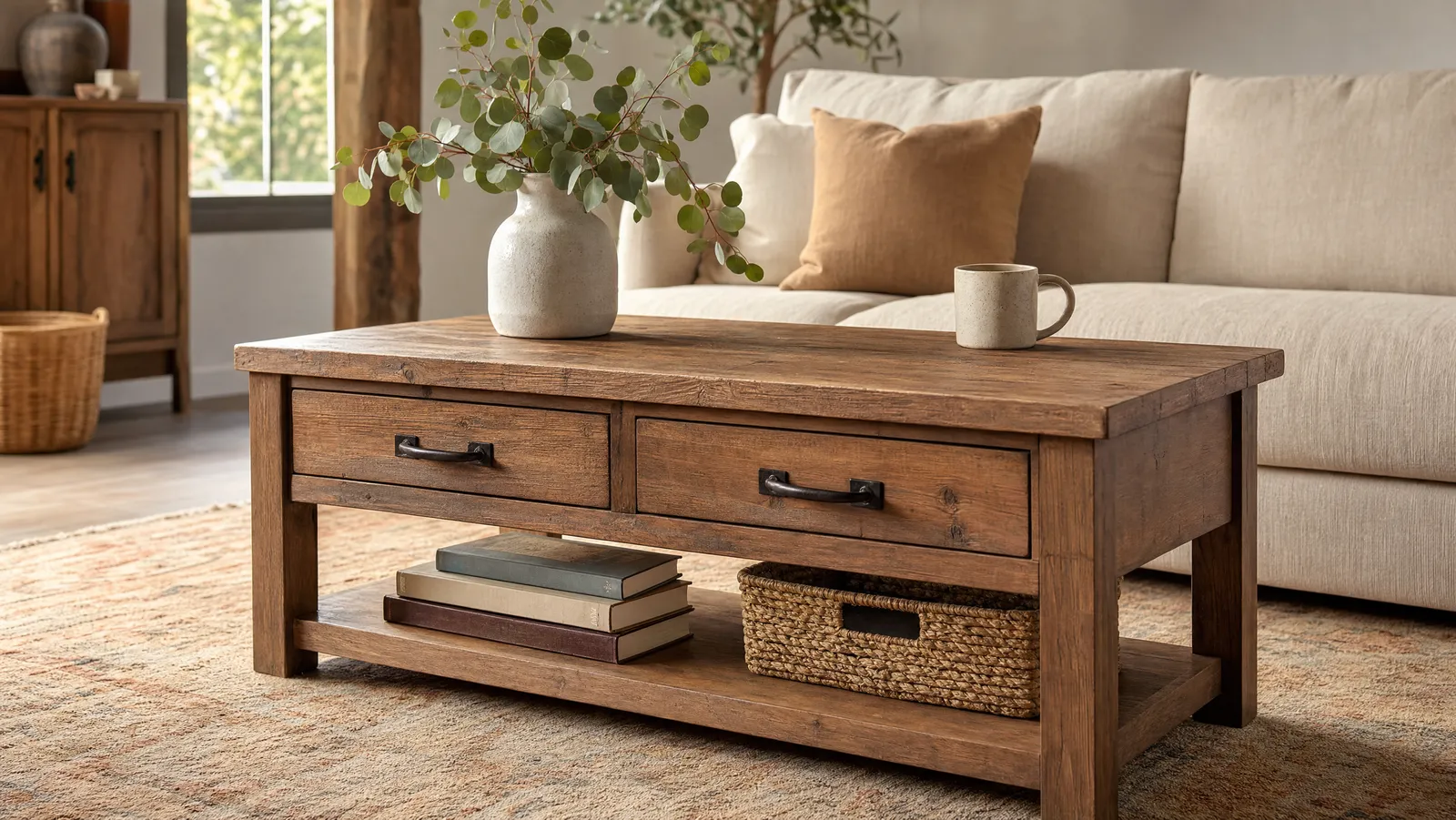
Drawers. The only storage that actually hides anything. The Solid Oak Coffee Table with Drawers pairs two drawers with an open shelf, which is the combination we would pick: the shelf for things you want to see, the drawers for things you do not. One planning note that catches people out — a drawer needs room to open, and on a coffee table that room comes out of the same 14 to 18 inches of clearance you left for your knees. Measure the drawer depth and check it fits.
Lift-top cavity. The largest volume of the three, because the whole tabletop is a lid. Good for board games, throws and controllers. Less good for anything you need often, since getting to it means clearing whatever is on top.
What honestly goes in a coffee table: remotes, coasters, chargers, a deck of cards, a couple of throws, kid stuff you want out of sight in thirty seconds. If your answer is "nothing", buy the table you like the look of and skip the storage premium. We size up capacity and drawer quality across formats in the best coffee tables with storage.
Small-Space Picks
Small rooms punish the wrong table twice — once for the floor it takes and once for the visual weight it adds.
- Go round, and go under 36 inches. A round table has no corners to catch a hip in a narrow pass, and it lets you walk a tighter arc around it. The 33-Inch Round Glass Coffee Table below is 33.4 inches across for exactly this reason: it clears a walkway that a 36 inch table pinches.
- Choose an open base and a clear top. Visual weight is about what you can see through. A tempered glass top over an open metal frame occupies floor space without occupying the sightline, which is why the Round Glass-Top Coffee Table works in an apartment where a solid wood block would not.
- Look at nesting pairs. Two tables that stack into one footprint give you a serving surface for guests and a small profile the rest of the week.
- Keep it low. A table at the low end of the height range keeps the sightline over it open.
- Do not undersize below usefulness. A 24 inch table in front of a full sofa looks like an accident. If two thirds of your sofa is 40 inches, buy near 40 and solve circulation with shape instead.
The trade-off with glass in a small space is maintenance: every fingerprint is visible, and small rooms tend to be high-traffic rooms. Our full roundup of the best coffee tables for small spaces covers nesting sets, C-tables and round options by diameter.
Placement and Clearance Rules
Placement is where the measurements from section one meet the rest of the room.
- Sofa to table: 14 to 18 inches. RoomSketch3D's clearance standards specify that range, and Keck describes roughly 18 inches as the comfortable reach zone. This is the number to protect when the room gets tight.
- Main walkway: 36 inches minimum. RoomSketch3D calls for at least 36 inches for a walkway through a room and 42 inches for comfort. Keck's guide is close, suggesting 30 to 36 inches for comfortable movement with 24 inches as the tight-space minimum. If the path from the door to the hallway runs past your table, it is a main walkway and it gets 36 inches.
- Between two furniture pieces: 30 inches minimum. That is RoomSketch3D's figure for a secondary walkway — the gap between the table and a side chair, for instance.
- Center on the sofa, not on the room. The eye reads the table against the sofa behind it. A table centered on the room but off-center to the sofa looks like a mistake even when nobody can say why.
- Get the table onto the rug. All four legs on the rug, with margin. A table with two legs on and two off wobbles and looks unresolved. Our guide to how to place an area rug covers which furniture goes on the rug in each common layout.
Test all of it with painter's tape before the delivery window. Tape the footprint, tape the 36 inch walkway, then walk the room carrying something in both hands. A layout that fails on tape will fail with real furniture in it. We publish room-by-room diagrams in coffee table placement and clearance.
The Coffee Tables We Recommend
Six tables, each solving a different version of the problem. Prices are as of August 2026 and move around.
Our pick: Two-Tier Solid Wood Coffee Table
The PADMA HOUSE two-tier table is the one we would buy without a specific reason to buy something else, at $221.35 as of August 2026 against a $232.99 list price. It measures 43.3 by 23.6 by 17.7 inches, which is the entire argument: 17.7 inches lands in the middle of the 16 to 18 inch band, and 43.3 inches is almost exactly two thirds of a 65 inch sofa. The frame and legs are solid wood, with a cherry brown birch veneer top over poplar and MDF, and four thicker legs with a small X detail brace the base. The open lower shelf takes the remotes and magazines that otherwise colonize the top.
The honest limits: the top is veneer over composite, not solid timber, so it will not take a sanding and refinish the way the oak pick will. And an open shelf shows what you put on it — buy two baskets at the same time.
Budget pick: Round Glass-Top Coffee Table
At $117.99 as of August 2026, down from a $128.00 list, the Henn and Hart 36 inch round table is the cheapest way we know to get a round, corner-free table into a small room. A 36 inch tempered glass top sits on a matte black open metal frame, and both halves of that description are doing work: the open frame and clear top leave the sightline through the table unbroken, so the room does not read as crowded. It ships in one to two days.
Two caveats. Glass shows every fingerprint, which in a high-traffic apartment means wiping it more than you expect. And the listing does not publish a height, so measure your sofa seat and confirm before ordering.
Also good: 33-Inch Round Glass Coffee Table
The Svmdcu 33 inch round table is the answer when 36 inches is three inches too many. It is 33.4 inches across in 0.3 inch tempered glass at an 18 inch height, on an MDF X-base with a gray wood-grain finish that is 1.5 inches thick and 7 inches wide in an interlocking cross-leg pattern. The wood-grain base gives it more warmth than an all-metal frame, and there are no sharp corners anywhere on it. The maker puts assembly at 10 to 20 minutes. It is $129.99 as of August 2026.
Watch the height. At 18 inches it sits at the top of the usable band, so on a low-seated sofa it will read tall.
Also good: 47-Inch Glass Coffee Table
For a wide sofa or a long sectional run, the 47 inch glass coffee table is the proportion fix, at $189.99 as of August 2026 against a $198.98 list. It measures 47.2 by 25.4 by 17.9 inches — a length that suits a sofa around 70 inches under the two-thirds rule, and a height right in the target band. The top is 0.32 inch tempered glass that the listing rates to a 300 pound load capacity, on MDF legs and a silver metal base. Assembly is stated at 10 to 15 minutes.
The trade-off is surface area cutting both ways: a big glass top is a big fingerprint canvas, and MDF legs are the part to keep dry.
Upgrade pick: Solid Oak Coffee Table with Drawers
The solid oak coffee table with storage is the one to buy if you want a table that outlives the sofa, at $339.99 as of August 2026. It is 39.37 inches wide in 100 percent solid FAS-grade North American oak with a walnut finish, with two drawers plus an open shelf and a stated capacity of up to 300 pounds. Edges are rounded and the design is elevated off the floor. This is the material argument from earlier made concrete: solid hardwood can be sanded and refinished, where a veneer top has one life. The drawers are the other half of the case — they are the only storage in this list that genuinely hides anything.
Two things to know. It costs nearly three times the budget pick. And the listing does not publish a height, so measure against your sofa seat before you order. Stock was thin when we sourced it, with only six units showing.
Also good: Lift-Top Coffee Table with Storage
If you eat or work on the coffee table, the Ashley Carynhurst lift-top table is the practical answer, at $475.19 as of August 2026 against a $527.99 list. It is 52 by 28 by 18 inches in reclaimed solid pine, finished in distressed light gray with a planked butcher-block wood effect, with two handles and bun feet. The top lifts to bring a laptop or a plate to a workable height and hides storage in the cavity underneath. Assembly is minor — screw in the feet.
It is the most expensive pick here, the lift mechanism is one more thing that can eventually fail, and at 52 by 28 inches it needs a genuinely large room. If those three things are fine, it is the most useful table on this list.
Conclusion
Start with the tape measure, not the photograph. Height within 16 to 18 inches and no taller than the sofa seat. Length near two thirds of the sofa. Clearance of 14 to 18 inches to the cushion and 36 inches for any real walkway. Get those right and a $120 table looks intentional; get them wrong and a $1,200 table looks like it wandered in from another room.
For most living rooms, the Two-Tier Solid Wood Coffee Table is our default: correct height, correct length for a standard sofa, and a second tier that solves clutter for around $221 as of August 2026. Buy the Solid Oak Coffee Table with Drawers instead if you want the piece to last decades and you want storage that closes. Buy the Round Glass-Top Coffee Table if the room is small and the budget is tight. Buy the Lift-Top Coffee Table with Storage only if you genuinely eat or work at the sofa, because that is the only thing that justifies the price and the mechanism.
And if the rug under all of this is still an open question, our guide to choosing an area rug covers size, fiber and construction — the rug sets the boundary the table has to live inside, so it is worth settling first.
Explore the full series
- Coffee Table Size and Height: The Complete Guide — The height, length, and clearance numbers that make a coffee table fit.
- Coffee Table Shapes: Round, Rectangular, Square and Oval — Round, rectangular, square, and oval compared on room fit and traffic flow.
- Coffee Table Materials Compared: Wood, Glass, Marble and Metal — Wood, glass, marble, metal, and rattan compared on durability, weight, and care.
- How to Style a Coffee Table (That You Still Use Every Day) — A repeatable styling formula that still leaves room for a coffee cup.
- Coffee Table vs Ottoman: Which Belongs in Your Living Room? — When a soft ottoman beats a hard table, and when it does not.
- Best Lift-Top Coffee Tables for Working and Eating on the Sofa — Lift-top tables that turn a sofa into a desk, and the mechanisms to avoid.
- Best Coffee Tables with Storage for Small Living Rooms — Drawers, shelves, and hidden compartments that earn their footprint.
- Best Coffee Tables for Small Spaces and Apartments — Small-footprint, nesting, and round picks for tight living rooms.
- What Coffee Table Works Best with a Sectional? — How to size and place a table against an L-shaped or chaise sectional.
- Coffee Table Placement: Clearance Rules for Every Living Room — How far from the sofa, how much walking room, and how it sits on the rug.
The Author
About the author
Interior Designer
Donald Martin
Designer since 2006 and a lifelong lover of rescued objects, Donald Martin knows how to give a second life to pieces and weave them into an eclectic, personalized interior. He writes about decorating real homes on a real budget.