Rugs · 13 min read
How to Place an Area Rug: Layout Rules for Every Room
 Donald Martin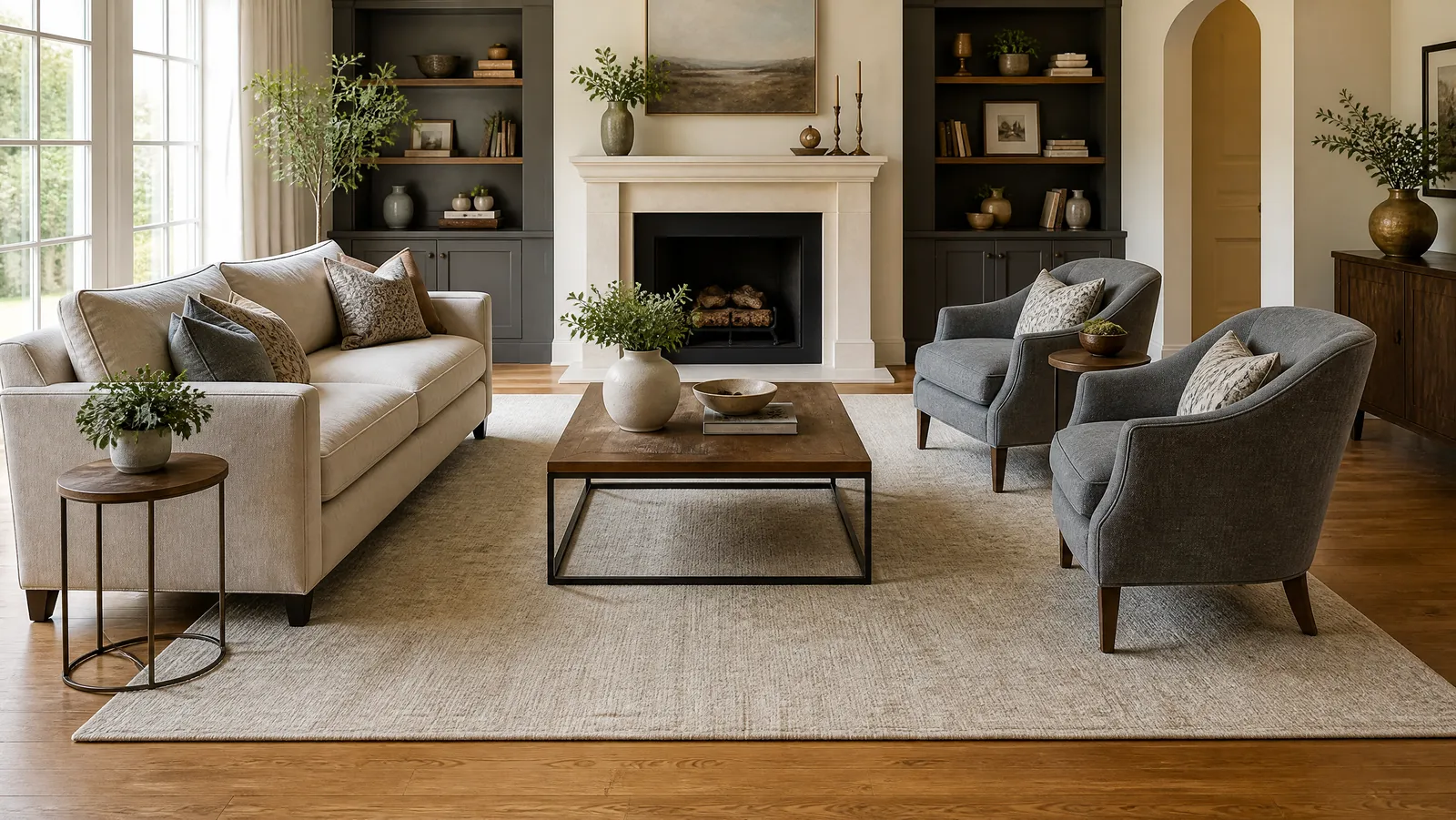
Place an area rug so it anchors the furniture, not the walls. In most living rooms, that means the front legs of every seat sit on the rug, an even border of bare floor frames the edges, the bedroom rug slides under the top two-thirds of the bed, and a dining rug extends about 24 inches beyond the table on all sides.
That is the whole system in one paragraph, and the rest of this guide is knowing which version of it applies to your room. One thing we will not do here is rehash size charts — this article is about position and orientation, and our complete area rug size guide owns the "what size do I buy" question, with our free rug size calculator doing the arithmetic for you. And if you are still shopping rather than arranging, start with our full pillar guide to choosing the right area rug, then come back here to put it on the floor correctly.
Area Rug Placement Rules: Three Principles Before You Move Anything
Every room-by-room rule below is a variation on three principles.
- The rug anchors the furniture group, not the room. A rug's job is to gather sofas, chairs, beds, or tables into one visual unit. It should always connect to the furniture it serves — a rug floating in open floor with nothing touching it reads as an island, not an anchor.
- Keep the border of bare floor even. Whatever gap you leave between the rug and the walls, keep it consistent on parallel sides. An even reveal is what makes a layout look deliberate.
- Be consistent with legs. All legs on, front legs on, or all legs off each work; a sofa half-on while its matching chairs float off does not. Pick one approach per furniture group and apply it to every piece.
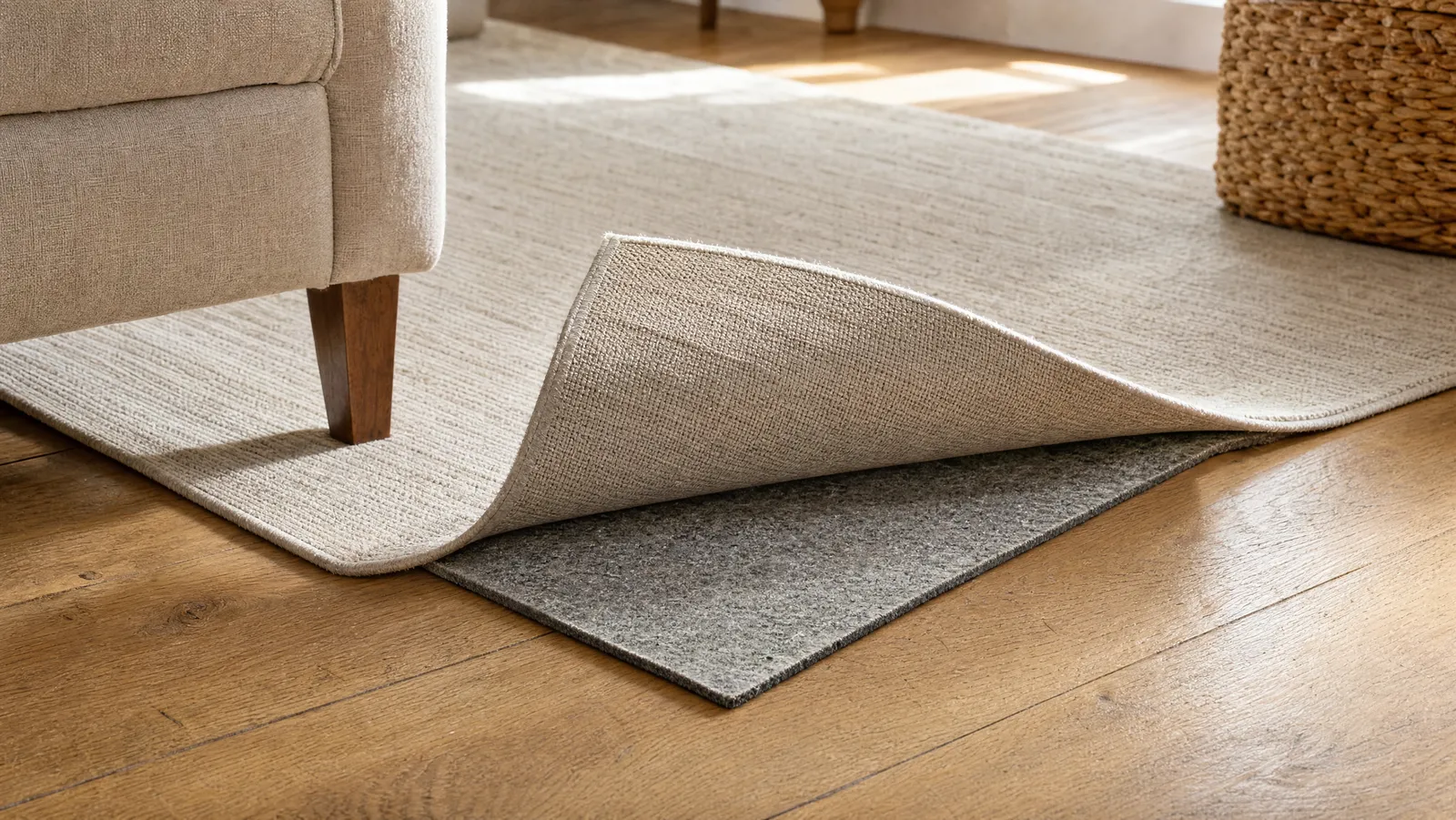
One practical note: place the rug first, then set the furniture on top. It is far easier to square a rug to the room when nothing is pinning it down, and a good rug pad will keep it from migrating once everything is in place.
Rug Placement in the Living Room: All Legs On, Front Legs On, or All Legs Off?
The living room question we hear most often is whether furniture legs go on or off the rug. There are exactly three defensible answers, and the right one depends on room size and the rug you own.
All Legs On
Every piece of seating — sofa, chairs, tables — sits fully on the rug, with the rug extending several inches past the furniture on every side. This is the most generous, most finished look: the rug reads as the floor of the seating area. Use it in large or open-plan rooms where the rug must define the conversation zone, and expect to need a 9x12 or larger to pull it off. One warning: an all-legs-on rug that barely clears the furniture looks pinched — if it cannot extend comfortably past the seating, use the next approach instead.
Front Legs On
The front legs of the sofa and chairs rest on the rug; the back legs stay on bare floor. This is the default we recommend for most living rooms, and it is the designer consensus too. According to Homes and Gardens, a living room rug should be large enough that at least the front legs of the sofa and any chairs rest on it — which for most living rooms means an 8x10 or 9x12. Front-legs-on knits the seating together, makes a mid-size rug look bigger than it is, and keeps the layout feeling relaxed rather than staged. Aim to get roughly the front third of each seat on the rug, and keep the depth of overlap similar from piece to piece.
All Legs Off
Every leg sits on bare floor, with the rug floating in the middle of the seating group — usually under just the coffee table. This only works in small rooms with small rugs (think 5x7 or under), where the rug functions as a centerpiece rather than an anchor. If you go this route, keep the gap tight: the rug's edge should sit close to the front legs of the seating, ideally within about 6 inches, so the rug still reads as part of the group. Any farther and you get the dreaded postage-stamp effect.
Should Area Rugs Go Under Furniture?
Yes — in most rooms, an area rug should go at least partly under the furniture. That is the direct answer, and it follows from the anchoring principle: a rug that touches nothing organizes nothing. Under the front legs of seating, under the top two-thirds of a bed, fully under a dining table and its chairs — in each case the overlap is what ties floor, rug, and furniture into one composition.
The exceptions are worth knowing:
- Wall-hugging case pieces stay off. Bookcases, media consoles, sideboards, and dressers that sit against the wall do not need to touch the rug; the rug serves the central furniture group, not the perimeter.
- Small accent rugs float on purpose. A 3x5 beside a bed, in front of a sink, or at a doorway is a landing pad, not an anchor, and lives on open floor.
- Very heavy pieces deserve a thought. A piano or a loaded sectional will crush high pile permanently; if that bothers you, go all legs off, or choose a flatweave that takes compression gracefully.
The Even-Border Rule: 8 to 18 Inches of Bare Floor
The border of exposed flooring around a rug is what frames the whole arrangement, and it is the number people most often get wrong — usually by buying too small and leaving a moat of bare floor. According to Houzz, the standard rule of thumb is to leave about 18 inches of bare floor between the rug's edge and the walls, and in a small room that border can shrink to about 8 inches. Inside that 8-to-18-inch range, let the room's scale decide: generous borders suit large rooms, tighter borders keep small rooms from feeling chopped up.
Two refinements make the rule work harder:
- Consistency beats the exact number. A 10-inch border all the way around looks better than 18 inches on one side and 6 on the other. Measure from the walls, not by eye.
- Wall-to-wall is not the goal. If the border shrinks much below 8 inches, the rug starts to imitate carpeting and you lose the framing effect entirely — at that point, a size down almost always looks better.
Bedroom Rug Placement: Under the Top Two-Thirds of the Bed
The bedroom rule is simple and nearly universal: slide the rug under the bed, perpendicular to it, covering roughly the top two-thirds of the bed — starting just in front of the nightstands rather than under them. The rug then extends past the sides and foot of the bed, which puts soft footing exactly where bare feet land every morning while letting the nightstands sit square on the floor.
The number that makes this layout work is the overhang. According to Bassett Furniture, the rug should extend at least 18 inches beyond the sides of a queen bed, which is exactly what an 8x10 delivers under a standard 60-inch-wide queen. For a king, step up to a 9x12 to hold that same reveal; anything narrower disappears under the mattress and reads as wasted money. In a smaller bedroom, a full-size rug can also run under the entire bed and nightstands — the luxury version of the layout — but only if you can still keep an even border of floor at the walls.
No room for a big rug at all? Runners are the honest alternative: one along each side of the bed, roughly as long as the mattress, plus an optional third across the foot. You get the barefoot landing zone for a fraction of the cost, and the bed itself stays on bare floor.
Dining Room Rug Placement: Chairs Stay on the Rug — Even Pulled Out
The dining room has the least negotiable rule in this entire guide: every chair must remain fully on the rug when pulled out for sitting. A chair with its back legs off the rug rocks, catches, and chews the rug's edge every single meal.
The working number is 24 inches. According to Rugs Direct, a dining rug should extend at least 24 inches beyond each side of the table to account for the distance chairs are pulled out when diners sit or stand — a pulled-out chair typically travels about 22 to 24 inches from the table edge before you can clear the seat. Measure your tabletop, add 48 inches to both the length and the width, and that is the minimum rug that will not fight your chairs — for a standard six-seat table, that lands at an 8x10.
Two placement refinements finish the job:
- Match the rug's shape to the table. Rectangular table, rectangular rug; round table, round or square rug. Center the rug under the table, then center the table-and-rug unit under the light fixture if you have one.
- Go flat underfoot. Dining chairs slide constantly, so a low-pile or flatweave rug outperforms anything plush here — chairs glide instead of plowing. Fiber matters as much as pile in a room built around food; our rug materials comparison covers which weaves shrug off crumbs and chair traffic.
Entryways and Hallway Runners: Orientation Is Everything
Runners have one orientation rule — the rug runs with the traffic, long side following the length of the hall — and one proportion rule: leave a few inches of floor showing on each side rather than running wall to wall. According to designer Emily Henderson, you want at least 3 inches between the runner and the wall on each side; most designers land in the 4-to-6-inch range for a balanced frame. Leave a similar reveal of about 6 to 12 inches at each end of the hall, and stop the runner short of any doorway rather than jamming it against the threshold.
In an entryway, center the rug on the front door and make sure the door swings cleanly over it — a low-profile flatweave earns its keep here. The entry rug is a landing pad, so it can float; it is the one spot in the house where a small rug touching no furniture is exactly right.
Open-Plan Rooms: One Rug Per Zone
In an open-plan space, rugs are not decoration — they are the walls. Give each furniture zone its own rug, sized and placed by that zone's rule: front legs on for the seating area, 24 inches of clearance for the dining table. The rugs, not the architecture, tell you where one "room" ends and the next begins.
Three guidelines keep multi-rug rooms coherent:
- Never share one rug between two zones. A single rug that catches the sofa and the dining table merges them into one mushy non-room. Separate rugs, separate zones.
- Leave real floor between rugs. A visible band of bare floor — a foot or more where the layout allows — acts as the hallway between zones. Rugs whose edges nearly touch look like a patchwork accident.
- Relate the rugs without matching them. Same palette or same fiber family, different pattern or scale, keeps the zones feeling like siblings rather than strangers. This is also where layering earns a mention — floating a smaller patterned rug over a larger neutral one to soften a big zone — a technique with enough rules of its own that we will cover it in a future guide.
Orientation: Which Way Should an Area Rug Face?
When a rectangular rug can physically fit either way, two rules settle the direction:
- Run the rug's long side parallel to the room's long side. Matching the rug's proportions to the room's proportions is the single fastest way to make a layout look intentional; a rug set crosswise in a long room fights the architecture.
- Center on the furniture group, not the room. If the seating is pushed toward the fireplace or the TV wall, the rug goes with it; centering the rug in the room while the furniture sits off-center leaves it half-empty on one side. Aligning the rug's center line with the sofa's center line is usually all the symmetry you need.
The exception that proves the rule: a rug set deliberately on the diagonal can energize a boxy room — but it is a statement, and it only works when everything else in the layout is disciplined.
Common Rug Placement Mistakes (and the Fast Fixes)
- The floating postage stamp. A too-small rug touching no furniture, adrift in bare floor. Fix: pull the seating in until front legs land on the rug, or move that rug to a bedside or entry where floating is correct.
- Inconsistent legs. Sofa on, chairs off. Fix: pick one approach for the whole group — front legs on is the forgiving choice.
- The lopsided border. Eighteen inches of floor on one side, four on the other. Fix: measure the reveal from each wall and re-square the rug before resetting the furniture.
- Dining chairs falling off the back edge. Fix: no styling trick saves this one — the rug must reach about 24 inches past the table, so recruit it for another room and size up.
- Runner jammed wall to wall. Fix: swap for a width that shows 3 to 6 inches of floor per side; the hall will instantly look wider.
- Blocking doors and vents. A rug that stops a door from swinging or sits over a floor vent will never stay put or lie flat. Fix: shift the rug, or choose a flatweave with a lower profile.
- Skipping the rug pad. Every layout rule fails once the rug starts wandering. A pad keeps placement placed — and protects the floor while it is at it.
The Takeaway: Anchor, Border, Repeat
Rug placement is not taste — it is a short list of numbers. Front legs on in most living rooms, with all legs on for large rooms and all legs off only for small ones. An even 8-to-18-inch border of bare floor at the walls. The top two-thirds of the bed on the rug with an 18-inch overhang at the sides. About 24 inches beyond a dining table so chairs never fall off the edge. Runners with a few inches of floor showing on each side, and one rug per zone in open plans, long side running with the room.
Walk your home with a tape measure and this list — most placement problems are ten minutes of furniture-shuffling to fix, and the rest are a size swap. And if the diagnosis is "wrong rug entirely," our complete guide to how to choose an area rug will get the replacement right the first time.
The Author
About the author
Interior Designer
Donald Martin
Designer since 2006 and a lifelong lover of rescued objects, Donald Martin knows how to give a second life to pieces and weave them into an eclectic, personalized interior. He writes about decorating real homes on a real budget.