Rugs · 15 min read
Do You Need a Rug Pad? Types, Benefits and How to Choose
 Donald Martin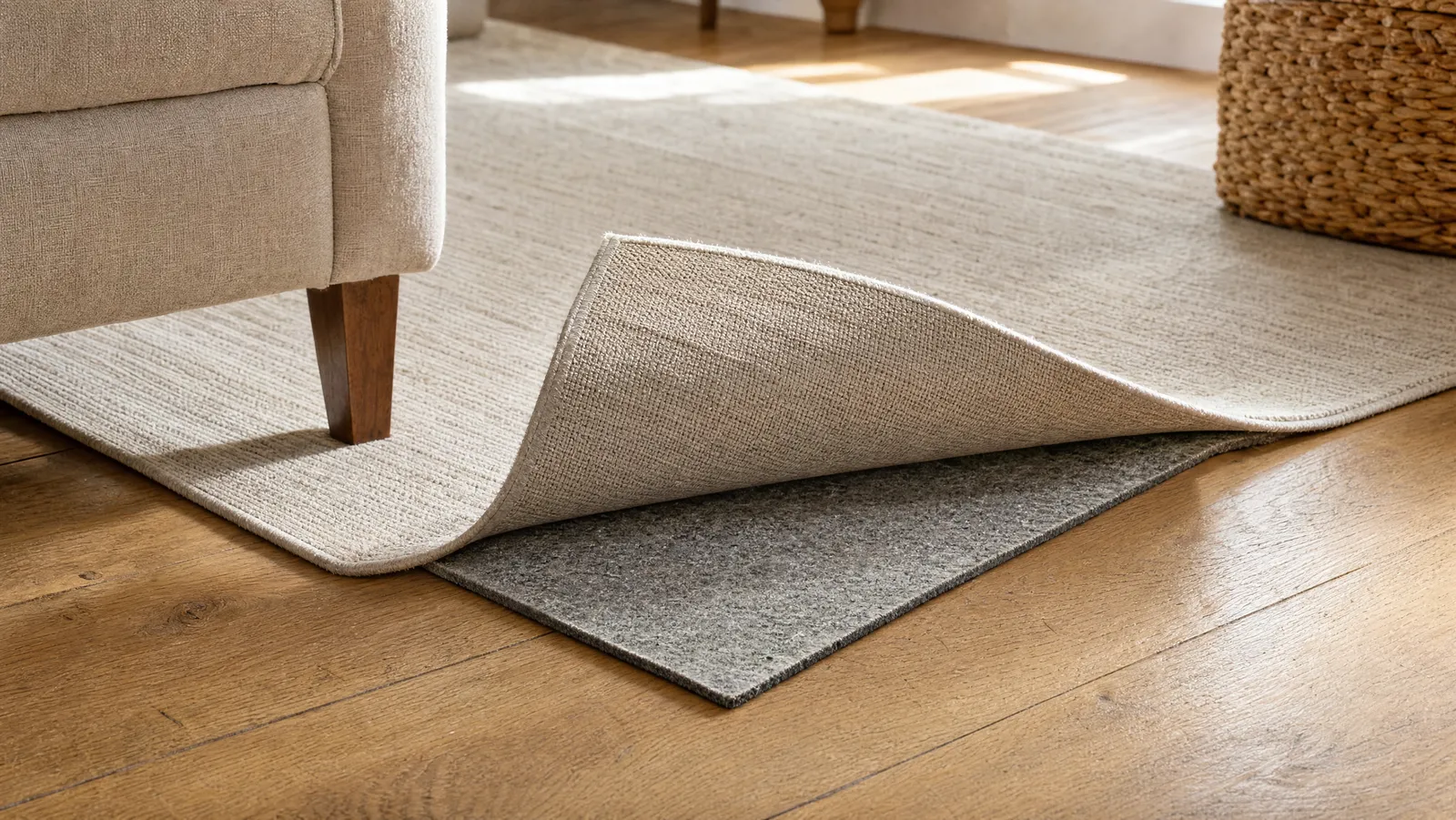
Yes, in almost every case you need a rug pad. It does three things the rug cannot do for itself: it stops the rug sliding underfoot, it puts a buffer between the rug's backing and your floor finish, and it absorbs the foot traffic that would otherwise crush the pile flat. A pad costing a fraction of the rug protects both the rug and a much more expensive floor.
Some links below are affiliate links; if you buy through them we may earn a small commission at no extra cost to you.
The harder question is which pad, and that is where most people get it wrong — usually by buying the cheapest waffle-weave sheet on the shelf and putting it face-down on beautiful oak. This guide covers what a pad actually does, the four materials worth knowing, how to pick a thickness, and the picks we would buy. If you are still shopping for the rug itself, start with our guide to choosing an area rug for your space and come back here before you check out.
What a Rug Pad Actually Does
Five jobs, in rough order of how much they matter.
It keeps the rug from moving. This is the safety argument, and it is not theoretical. In a CDC analysis of national emergency-department surveillance data from 2001 to 2008, published in the Journal of Injury and Violence Research and indexed on PubMed, an estimated 37,991 adults aged 65 or older were treated annually in U.S. emergency departments for falls associated with carpets and rugs, with rugs accounting for 45.8 percent of those cases and 72.8 percent of the falls happening at home. The authors report that fall injuries frequently occurred at the transition between carpet or rug and non-carpeted floor and on wet rugs, and they describe loose, unsecured rugs and curled edges as recognized environmental hazards — the failure modes a pad is meant to prevent.
It protects the floor. The underside of a rug is not soft. Jute and cotton backings, latex-tufted rugs and stiff machine-woven bindings all grind grit into a finish every time someone walks across them. A pad keeps that abrasion off the floor and gives dust somewhere to go other than into the finish.
It makes the rug last longer. According to Living Cozy's rug pad primer, a proper pad absorbs the majority of the impact from foot traffic and distributes weight more evenly, which reduces fiber crushing and premature wear. On a wool rug you plan to keep for twenty years, that is the difference between a heirloom and a flattened traffic lane.
It adds comfort and quiets the room. Felt is the ingredient doing this work. A 1/4-inch felt layer turns a thin flatweave from "sheet of fabric on plywood" into something you will actually sit on, and it takes the hard edge off footsteps in an apartment.
It makes vacuuming easier. A rug that stays put lets the vacuum do its job instead of dragging the rug along with it, and the slight give a felt pad adds may help a beater bar lift dirt out rather than shove the rug around.
Do You Always Need a Rug Pad? The Honest Exceptions
Almost always, but not literally always. Skip the pad when:
- The rug already has a bonded non-slip backing and it sits on hard floor. Many washable rugs ship with TPE or rubber backings, and their makers generally treat a separate pad as unnecessary. Adding one may even reduce grip, so check the rug maker's guidance first.
- It is wall-to-wall broadloom carpet you are covering with a low-pile rug that never moves and never wrinkles. If it does wrinkle — and most do — you want a felt-down, rubber-up pad specifically made for carpet.
- You are under a very heavy, immovable piece like a piano, a loaded sectional or a platform bed that pins the whole rug. Grip is irrelevant; you may still want felt for floor protection, but it is a comfort call.
- The rug is a genuine antique with a fragile foundation. Talk to a rug conservator before you put anything under it. Some old pieces need a specific inert underlay.
Every other situation — hardwood, tile, laminate, luxury vinyl, polished concrete, and the vast majority of area rugs sold today — is a pad situation.
Rug Pad Types Compared: Felt, Rubber, Felt and Rubber, and PVC
There are only four categories worth your attention, and the choice is mostly about which of grip and cushion you need.
- Felt and natural rubber — strong grip, good cushion. Best for any rug on any hard floor; this is the default. Trade-off: it costs the most per square foot.
- Natural rubber only — strong grip, minimal cushion. Best for doorways, runners and low clearances. Trade-off: no comfort, no insulation.
- Felt only — no grip, the best cushion. Best for heavy rugs pinned by furniture and for rugs laid over carpet. Trade-off: it will not stop a rug moving.
- PVC or foam waffle — fair grip at first, poor cushion. Nothing we would recommend. Trade-off: it degrades, sticks, and can discolor floors.
Felt and rubber is the combination we buy. RUGPADUSA's guide to choosing a pad describes the split of labor plainly: the felt upper layer fastens to the rug's fibers and keeps it from wrinkling and bunching, while the natural rubber backing grips the floor. Jaipur Rugs' rug pad guide makes the same point about hard floors, saying hardwood calls for non-staining rubber blends while carpeted floors need friction-based stabilizing pads.
Natural rubber only pads are thin, open-weave meshes bought purely for grip. RUGPADUSA describes its low-profile natural rubber pad as thin enough to allow for door clearance while facilitating airflow, which is the case for using one — hallways, entryways, under a swinging door. They do little for comfort or noise.
Felt only pads are the opposite trade: dense felt is what delivers cushioning, sound absorption and insulation, but it provides no grip. RUGPADUSA positions its felt-only pads for large or oversized rugs (8x10 and up) that stay put on their own, and Mohawk states outright that its felt-only pad is not intended to stop rugs from slipping. Believe that warning. It matters where the rug lands relative to your sofa and bed, so read how to place an area rug before you commit to a felt-only pad — if the furniture is not sitting on the rug, felt alone will let it wander.
PVC and foam waffle pads are the cheap ones sold folded in a bag. They tend to grip acceptably for a season, then compress, crumble and, in the worst case, leave residue on the floor finish. We cover why in the hardwood section below.
Rug Pad Thickness: 1/8, 1/4 or 1/2 Inch?
Thickness is where personal preference meets door clearance. The practical version:
- 1/8 inch — for entryways, hallway runners, kitchens, and anywhere a door has to clear the rug. The Gorilla Grip pad below measures 0.13 inches, which is enough grip and abrasion protection without raising the rug noticeably.
- 1/4 inch — the default, and the thickness we recommend for most rooms. Chairish's rug pad guide calls a standard 1/4-inch pad the right fit for most residential applications. In a dining room, go thinner: Atlanta Designer Rugs advises prioritizing density and rubber content over thickness there and suggests a 1/8- to 3/16-inch pad, so chair legs slide instead of catching.
- 1/2 inch — for thin flatweaves, kilims and low-pile rugs in bedrooms and living rooms where you want the floor to feel soft. It is a real luxury upgrade and a real commitment.
Two cautions on the thick end. RUGPADUSA warns that pairing a large rug with the thickest available pad can create a tripping hazard, because the edge of the assembly sits high enough to catch a toe. And a thick pad under a plush high-pile rug is redundant — you are stacking softness on softness and making the edges harder to keep flat.
Match thickness to the rug, not to your enthusiasm: thin rug, thick pad; thick rug, thin pad.
Sizing and Trimming a Rug Pad
Buy the pad in your rug's nominal size, then cut it down. According to Rugs Direct's guide to cutting a rug pad, the pad should end up roughly 1 to 2 inches smaller than the rug on every side, which for an 8x10 rug (96 by 120 inches) means a finished pad of roughly 92 to 94 by 116 to 118 inches. Size it flush with the rug and the edges lift, exposing the pad and creating the raised lip that catches feet; cut it too small and the rug's perimeter curls.
The method takes ten minutes:
- Measure the rug itself, not the room. Rug dimensions are frequently a couple of inches off the label.
- Roll the pad out flat and let it relax for an hour or two so creases settle.
- Lay the rug on top, centered, and mark the cut line 1 to 2 inches inside the rug's edge on all four sides.
- Cut. Rugs Direct notes that scissors work well for felt and lightweight foam, but thicker rubber and dense non-slip pads cut far more cleanly with a utility knife.
If you are sizing the rug rather than the pad, our guide to area rug sizes walks through what fits each room, and the same 1-to-2-inch rule applies to whatever you land on. For runners and odd shapes, every pad in our picks below is trimmable.
The Hardwood Warning: What Can Actually Damage a Finish
This is the part worth reading twice, because the wrong pad does not just underperform — it leaves marks you cannot buff out.
The mechanism is chemical. According to Garrison Collection's guide to flooring-safe rug pads, rubber and vinyl are popular in rug pads for their grip, but they can release plasticizers, and those chemicals interact with wood finishes to leave stains, sticky residue or discoloration behind. The same guide says rubber and vinyl pads can off-gas when exposed to heat or sunlight, and that the off-gassing can react with a floor's finish and leave a dull or hazy appearance. It adds that non-breathable backings can trap moisture between the pad and the floor.
The trade guidance points the same direction. Writing in Hardwood Floors Magazine, the National Wood Flooring Association's own publication, the NWFA's Brett Miller tells installers to take special precautions with the non-skid pads commonly placed under area rugs, because some of them may imprint their pattern onto the finish or the wood floor itself — and that rugs should generally stay off a newly finished floor for a minimum of seven days after the final coat, with the finish manufacturer's own guidance taking precedence. If your floor was refinished this month, wait.
What to do instead:
- Favor natural materials over vinyl and foam. Garrison Collection's guide reports that the NWFA points consumers to felt and jute, which do not release plasticizers. Among grippy pads, RUGPADUSA states that the natural rubber backing on its own pads will not stain, strip or damage hard flooring and contains no glues, PVC or adhesives. That is the manufacturer's claim rather than an independent test result, so treat it as a starting point, not a guarantee.
- Let the floor breathe. Garrison Collection's guidance is that non-breathable backings can trap moisture between the pad and the floor, while natural materials promote air circulation — one reason needle-punched felt layers, which RUGPADUSA says prevent moisture buildup, show up on better pads.
- Lift and check twice a year. Any discoloration, tackiness or residue is your signal to replace the pad immediately.
- Confirm compatibility with your specific finish. Waterborne, oil-modified and hardwax-oil finishes behave differently, and the flooring maker's instructions outrank any pad marketing copy.
If you are choosing a rug for wood floors in the first place, our roundup of the best area rugs for hardwood floors covers which constructions play nicely with a finish.
The Rug Pads We'd Buy
All six are 8x10, the size most people need, and all six trim down.
Best overall: Mohawk Home non-slip felt and latex pad
The Mohawk Home Non Slip Rug Pad is the one we would put under a typical living-room rug. It is 1/4-inch recycled felt bonded to a latex rubber gripper, and Mohawk says the rubber prevents slipping, sliding, bunching and wrinkles on hardwood, tile or carpet. The genuinely useful feature is that it is reversible: Mohawk specifies felt side up on hard floors, where the company says it protects against scratches, and felt side down when the rug is going over carpet. It trims with scissors, cleans by vacuuming or shaking, and Mohawk makes it in the USA with a 1-year limited warranty against manufacturing defects. At about $60 as of August 2026 for an 8x10, it is the value pick. The caveat: the gripper is latex rather than natural rubber, so on a freshly finished or delicate floor we would check the flooring maker's guidance first.
Best for hard-surface floors: RUGPADUSA dual surface 1/4 inch
If your floor is the expensive part of the equation, the RUGPADUSA Dual Surface 1/4-inch pad is worth the premium. Same felt-and-rubber concept, but RUGPADUSA says this one is built on natural rubber with no glues, PVC or adhesives — the direction the flooring-safe guidance above points. RUGPADUSA also describes the recycled felt as needle-punched to prevent moisture buildup, and odorless, low-VOC and hypoallergenic. It runs about $90 as of August 2026, roughly 50 percent more than the Mohawk in the same spec, which is the whole trade-off in one sentence.
Best thick cushion: RUGPADUSA dual surface 1/2 inch
For a thin flatweave in a bedroom or a reading corner you actually sit on the floor in, the RUGPADUSA 1/2-inch pad is a different experience underfoot. RUGPADUSA puts it at 50 ounces of felt and 14 ounces of rubber per square yard, approximately 1/2 inch thick throughout. It is about $130 as of August 2026 and it is not for dining rooms, tight door clearances, or anywhere the raised edge would be a hazard.
Best low-profile: Gorilla Grip 1/8 inch
Where clearance rules — entryways, under a swinging door, a kitchen runner — the Gorilla Grip felt-with-rubber pad is the answer. Gorilla Grip specifies 0.13 inches thick and pairs condensed needle-punch felt with a textured TP rubber underside rather than using felt alone, which is why it grips where a pure felt pad would not. About $85 as of August 2026. At 1/8 inch you get grip and abrasion protection, not comfort.
Best felt-only: Mohawk Home felt pad
Read this one carefully. The Mohawk Home Felt Rug Pad is a felt-only pad, and Mohawk states plainly that it is not intended to stop rugs from slipping — the company specifies it for heavy rugs or rugs anchored by heavy furniture or decor. Within that lane it is excellent and cheap, at about $46 as of August 2026, and it comes in 1/4-inch, 3/8-inch and 1/2-inch thicknesses so you can dial in cushion. Use it under a heavy wool rug that lives beneath a sectional. Do not use it under a lightweight rug in an open walkway.
Budget pick: TUOTPE waterproof felt and TPR pad
The TUOTPE Non-Slip Rug Pad is the one we would buy for a kid's room or a pet-heavy den, at about $50 as of August 2026. TUOTPE says the felt face grips the rug to stop curling and creeping and that the TPR backing is waterproof, which should keep a spilled cup from reaching the floor underneath. TUOTPE describes the TPR as safe on hard surfaces including hardwood and tile and says it will not stain or leave marks — a manufacturer claim rather than an independent finding, and TPR is a synthetic thermoplastic rather than natural rubber. The maker recommends cutting it about 2 inches smaller than the rug.
Caring for a Rug Pad, and When to Replace It
Pads are close to maintenance-free, but they are not permanent.
- Vacuum or shake it out whenever you deep-clean the rug. Mohawk specifies exactly that for its pads. Grit that works through the rug ends up on the pad, and grit is what abrades a finish.
- Lift and air it after any spill that soaks through. A damp felt pad trapped against wood is a genuine problem; get air to both surfaces before the rug goes back down.
- Rotate the rug, not the pad. Rotating the rug twice a year evens out wear and sun-fading; the pad can stay put.
- Replace when the felt compresses. If the pad no longer springs back after you lift the rug, it has stopped absorbing impact and is only taking up height.
- Replace immediately if the backing feels tacky, has begun crumbling, or has left any color, residue or pattern on the floor. That is not a wear issue, it is a chemistry issue, and it gets worse.
A quality felt-and-rubber pad can outlast more than one rug. A cheap PVC waffle pad may give up years sooner, which is the honest math behind spending more up front.
The Bottom Line
Buy the pad. On hard floors, buy felt and natural rubber at 1/4 inch, cut it 1 to 2 inches smaller than the rug on every side, and skip anything made of PVC or foam no matter how cheap it is. Go to 1/8 inch where a door has to clear, go to 1/2 inch where you want the floor to feel soft, and use a felt-only pad only when heavy furniture is doing the anchoring.
Our default recommendation for most homes is the Mohawk Home non-slip pad for value, or the RUGPADUSA 1/4-inch dual surface pad if your floor is worth insuring against a discoloration you cannot undo. And if the rug itself is still an open question, our area rug buying guide covers size, fiber, pile and construction in one place — the pad is the last decision, not the first.
The Author
About the author
Interior Designer
Donald Martin
Designer since 2006 and a lifelong lover of rescued objects, Donald Martin knows how to give a second life to pieces and weave them into an eclectic, personalized interior. He writes about decorating real homes on a real budget.