Rugs · 14 min read
Best Area Rugs for Hardwood Floors (That Won't Scratch)
 Donald Martin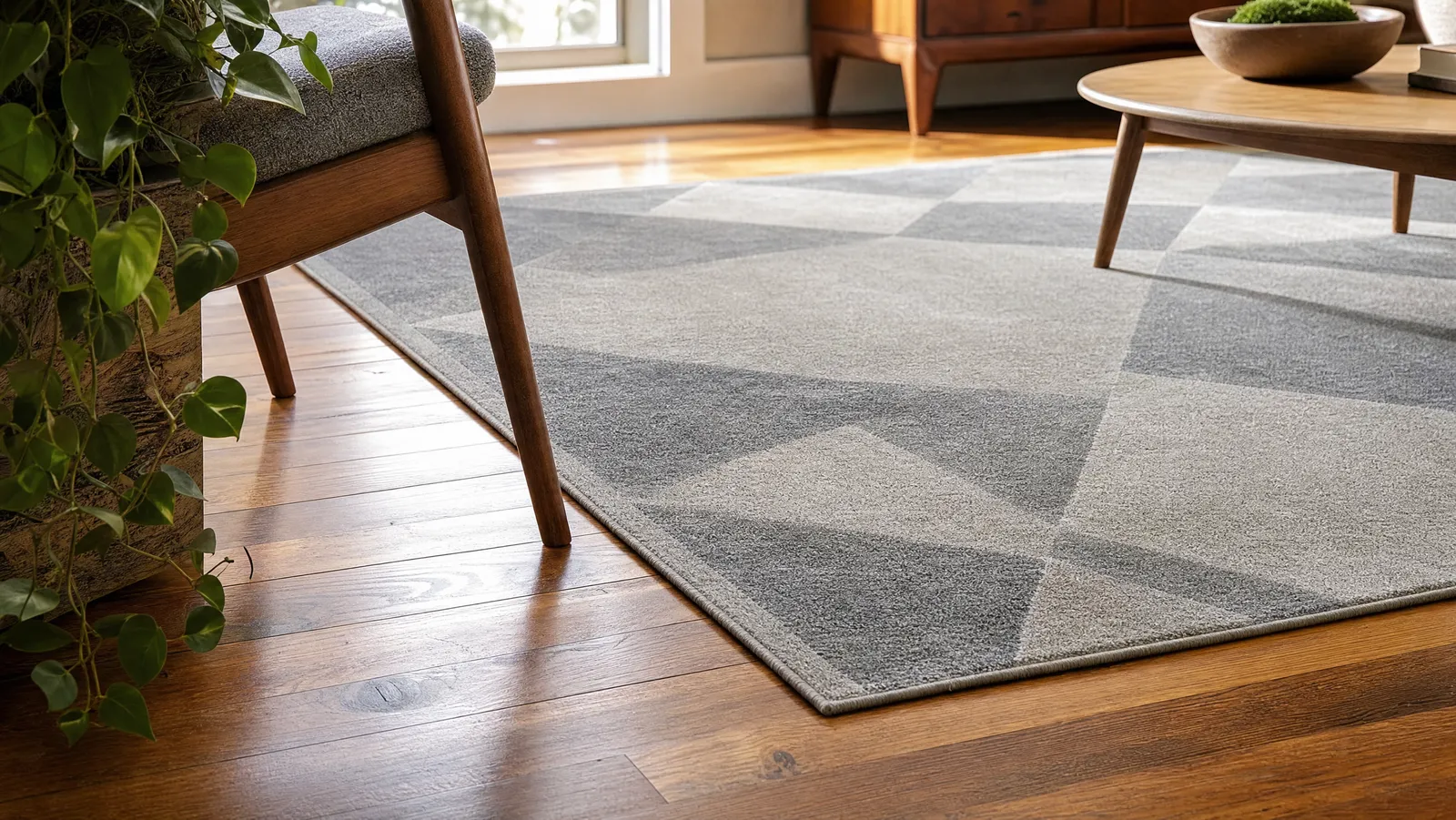
The best area rugs for hardwood floors get three things right: a backing that grips without migrating into the finish, a low pile that clears doors and traps less grit, and a separate pad between rug and wood. Our top pick is the TWINNIS 8x10 washable geometric rug, a low-pile velvet with a TPR backing the maker specifies for hardwood.
Some links below are affiliate links; if you buy through them we may earn a small commission at no extra cost to you.
Wood floors are the one surface where the underside of a rug matters more than the top of it. A rug that looks perfect for five years can leave behind an orange shadow, a dull matte patch, or a strip of crumbled backing welded to your polyurethane. If you want the full decision framework before you shop, start with our guide to choosing an area rug; this roundup narrows that framework down to the specific things that protect a wood finish.
What makes a rug safe for hardwood floors
Five criteria, in the order we'd weigh them:
- Backing material. The single biggest variable. You want grip that doesn't chemically interact with a floor finish or seal moisture against it.
- Pile height. Low pile (roughly 0.2 to 0.3 inch) clears doors, sits flat under furniture, and gives grit less room to hide.
- A pad underneath. Even a well-behaved rug backing benefits from a buffer layer. More on this below.
- Edge construction. Bound or reinforced edges stop the fraying that turns a rug into a trip hazard on a slick floor.
- Cleanability. Grit is what actually scratches wood. A rug you can shake out, vacuum easily, or throw in a machine keeps that grit from accumulating.
Notice what isn't on the list: fiber content. Polyester, polypropylene, and wool can all work on wood. It's the coating on the back that tends to cause the trouble.
The backing problem: the best rug backing for hardwood
Here's the failure mode that ruins floors. According to Engineer Fix, the plasticizers added to synthetic rug backings to keep them flexible and soft can leach out over time, chemically reacting with and softening the polyurethane finish underneath and leaving what it describes as a distinct yellow or brown stain that mirrors the pattern of the rug backing. RugPadUSA adds the moisture half of the problem: a latex-backed rug is not breathable, so it traps moisture between rug and floor, which in turn causes dampness and discoloration.
Time makes it worse. According to Sisal Carpet's guide to latex backing removal, the latex coating on tufted rugs and natural-fiber rugs breaks down as it ages and can leave residue stuck to the floor beneath it, which then has to be scraped or solvent-cleaned off the finish. This is a slow problem, not a dramatic one, which is exactly why people miss it: nothing looks wrong for years, and then you move the rug.
Your finish decides how bad it gets. According to a flooring-safe rug pad guide from Garrison Collection citing the National Wood Flooring Association, that chemical interaction is particularly problematic with oil-based and some water-based finishes, which the NWFA describes as highly sensitive to it. And the NWFA itself points out that wood is an organic material that reacts to its environment: in humid conditions it gains moisture and can swell. A non-breathable layer that keeps normal household humidity from evaporating is working against that, which is the argument for something you can get air through.
So what should you actually look for? The current answer from the manufacturing side is thermoplastic rubber (TPR) or thermoplastic elastomer (TPE) rather than old-style latex or PVC. According to Engineer Fix's explainer on TPR backing, TPR is described as non-marking and is considered a safer option than PVC, which can contain plasticizers that react with and stain some flooring, and TPR is formulated to resist the drying, cracking, and crumbling that ages traditional backings.
We'd treat that as a strong reason to prefer TPR and TPE over unlabeled "rubber" or latex, but not as a guarantee. No independent long-term testing that we could find covers every combination of backing formula and floor finish, and finishes themselves vary enormously — an oil-finished white oak floor is a different chemistry problem than a factory-cured aluminum-oxide urethane. Every rug in this roundup lists TPR, TPE, or rubber as its backing, and in each case that's the maker's description, not our lab result. Our practical position: buy the TPR or TPE rug, and still put a pad under it. If you want to go deeper on how fiber and backing choices interact, our breakdown of rug materials compared covers the surface side of the same question.
Pile height: why low pile wins on wood
Grit, not the rug, is what scratches a floor. According to Atlanta Designer Rugs, the fine sand and dirt that works its way under an unpadded rug grinds against the floor finish every time someone walks across it — and pile height is the variable that decides how much of it is in there. That guide puts pile above 1 inch in the category that holds grit deep in the fibers, and flat-weaves at 0 to 3mm in the range where it says hardwood finish damage risk drops to near zero.
The practical arguments stack up the same way:
- Door clearance. A 0.2 to 0.3 inch pile plus a thin pad usually slides under an interior door. A shag will not.
- Furniture stability. Chair and table legs don't sink into a low pile, so nothing rocks and nothing grinds.
- Vacuuming. Short fibers give up dirt readily, which means less grit reaching the floor in the first place.
- Rolling loads. Desk chairs and vacuums roll over low pile without dragging the rug across the boards.
In a busy hallway or a room where dogs and kids run the show, durability starts to matter as much as pile height — we cover that trade-off separately in our roundup of the best area rugs for pets and high-traffic homes.
Best overall for hardwood: TWINNIS 8x10 geometric
The TWINNIS 8x10 geometric patchwork rug is our pick because it's the one here explicitly built for the job. TWINNIS says its TPR backing sits tightly on hardwood or tiled floors for stability, and the surface is a low-pile velvet that fits under most doors while keeping the crisp triangles and rectangles of the patchwork pattern from blurring. It's non-shedding, it washes in cold water, and the maker says the dense velvet resists spills penetrating, with surface marks wiping off with a cloth.
At 8x10 it's the only pick that will comfortably reach the front legs of a full seating group, which is what most people actually need in a living room. The trade-offs: it's the most expensive rug on this list at $109.99 as of August 2026, and because the low pile ships folded, TWINNIS says creases need a few days lying flat before they disappear. Best for: a living or family room where you want room-sized coverage and a backing the maker has specified for wood.
Best for bedrooms: DUKINO 5x8 floral
At 0.2 inch, the DUKINO 5x8 floral rug has the lowest stated pile in this roundup, and that's the number that matters in a bedroom, where you're threading a rug under a door swing and around a bed frame and nightstands. DUKINO pairs a non-slip TPR backing with reinforced edges and minimal shedding, and it's machine washable, with stains wiping off and daily dust coming up under a regular or robot vacuum.
The honest catch is aesthetic, not technical: the vintage floral motifs come in a colorful print, so this is a rug you decorate around rather than a quiet neutral. DUKINO also notes that shipping creases take one to three days to flatten under a heavy object or by reverse-folding. Best for: a bedroom with tight door clearance where you want pattern rather than a solid. It runs $79.99 as of August 2026.
Best dark color for hardwood: Lahome 5x7 dark academia
Dark rugs read beautifully against mid-tone oak, and the Lahome dark academia 5x7 is the cheapest way we've seen to do it well. It's a faux-wool polyester face over a rubber backing that Lahome says keeps it in place on hard floors, and the maker describes the rug as low-odor and ultra-thin, with a profile designed to prevent snagging on doors. The 5x7 size washes in a home machine, which matters given a black rug shows everything.
Two honest caveats, both from Lahome itself. Care is stricter than the others: use suction-only or low-pile mode and avoid rotating bristle bars, which rules out a standard beater-bar upright. And the maker notes that stroking the pile can reveal the undyed white fiber root, calling it normal for dense weaving — worth knowing before you unroll a black rug and see pale streaks. Best for: a moody sitting room or study on a light wood floor, at $42.99 as of August 2026.
Best patterned low-pile rug: SIILOOM 5x7 medallion
The SIILOOM 5x7 washable rug is the pick for people who want to measure before they buy: the maker publishes both dimensions and thickness, 60 by 84 inches at 0.24 inches, so you can check door clearance with a tape measure instead of guessing. It's a 100% polyester face over a TPE backing SIILOOM calls skid-resistant, in a low-pile, non-shedding construction and a vintage-inspired symmetrical medallion design that hides everyday traffic better than a solid. Washing is cold-water only, with no bleach so the print holds.
The trade-off is that 0.24 inches makes it the thickest of these low-pile picks, and SIILOOM suggests a low-speed or robotic vacuum to keep the rug from shifting during cleaning — so if you own a powerful upright, expect to run it on a reduced setting or hold the rug edge. Best for: a dining nook, entry hall, or bedroom where a medallion pattern earns its keep. It's $69.99 as of August 2026.
Best small rug for entryways: Goideal 4x6
Entryways are where hardwood takes the most abuse, because that's where the grit arrives. The Goideal 4x6 washable rug is a cheap, sensible answer: a thin, lightweight grey rug that Goideal says resists trapping dirt, stays non-shedding, and folds for storage, over a TPR rubber backing the maker describes as gripping the floor firmly to prevent slipping. It's washable and colorfast, so it goes in the machine for a real deep clean rather than a surface vacuum — which is the whole point of a rug that catches street grit.
The limits are obvious from the size. At 4x6 this suits doorways, dorm rooms, nurseries, and laundry rooms; it won't reach the front legs of a sofa. Goideal also says shipping creases take three to five days to flatten laid flat, or faster under something heavy. Best for: the first six feet inside a door, at $37.99 as of August 2026.
Why a rug pad is not optional on wood
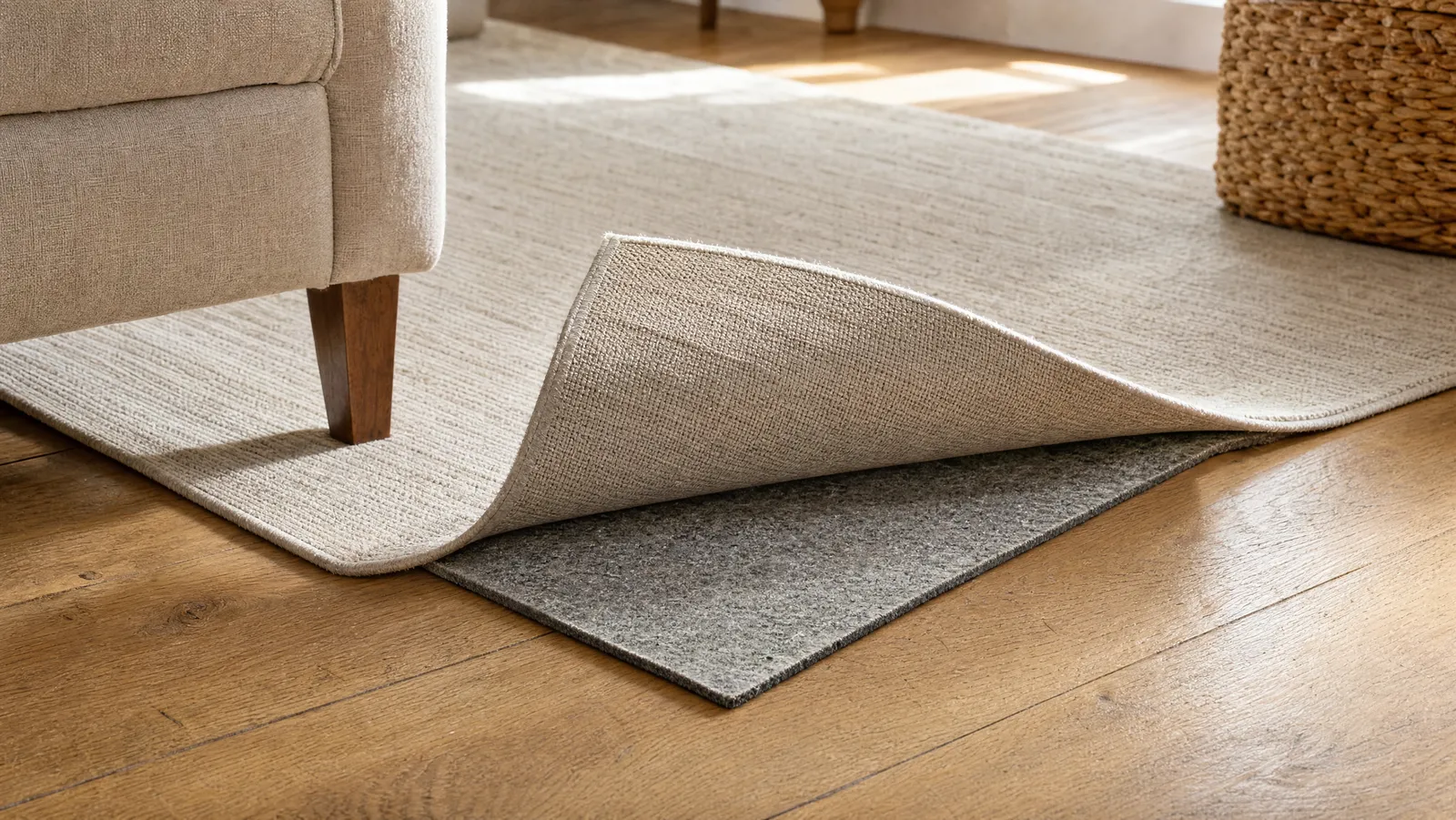
A non-slip backing solves sliding. A pad solves everything else. It puts a physical buffer between the rug's coating and your finish, it keeps the rug off the boards so air can move underneath instead of humidity sitting trapped there, and it absorbs abrasion that would otherwise go straight into the wood — recall that Atlanta Designer Rugs pins the grinding problem specifically on grit under an unpadded rug. According to Zerorez, high-quality rug pads don't damage the flooring; they reduce wear and tear on it.
Choose the pad with the same suspicion you applied to the rug. The same Garrison Collection guide emphasizes breathability and points to felt and jute as the NWFA-endorsed pad materials. A felt-and-natural-rubber pad is the usual compromise: felt for the cushion and breathability, a thin waffle of rubber for grip. Solid, sheet-style rubber or PVC pads are the ones to skip on wood.
Two practical notes. Cut or buy the pad about an inch shorter than the rug on each side so it disappears under the edges. And check underneath it twice a year — lift a corner, look for haze or color change, and move on quickly if you see any. Our full explainer on whether you need a rug pad walks through thicknesses and materials in more detail.
Placement and care on hardwood floors
Size it to the room, then to the furniture. The usual designer guideline is the 18-inch rule. According to Edward Martin, that means leaving around 18 inches of exposed floor between the rug's edges and the surrounding walls, scaling that border down to 12 inches or even 10 in smaller rooms. It's a rule worth following on wood specifically, because the exposed border is the material you paid for. Get at least the front legs of your seating onto the rug.
Rotate the rug, not just the furniture. Anything covered is shielded from sunlight, and that protection shows up as a permanent outline. According to 651 Carpets, wood reacts to sunlight and UV light can change its color quickly, so anything that blocks light or throws a shadow should be rotated around — that way the same spots are not always the shaded ones, and any color change spreads out evenly instead of leaving a hard tan line. In a room with strong afternoon sun, moving a rug every month or two is not overkill.
Move furniture, don't drag it. Felt pads under every leg, and lift rather than slide when you rearrange. A dragged chair leg can do more visible damage in seconds than a rug does in years.
Vacuum both sides. Once a season, take the rug outside, shake it, and vacuum the floor underneath. That's where the grit lives.
FAQ
Do rubber-backed rugs damage hardwood floors?
They can. Engineer Fix describes plasticizers leaching out of synthetic backings, reacting with and softening the floor's polyurethane finish and leaving a yellow or brown stain in the shape of the backing, and RugPadUSA notes that a non-breathable latex backing traps moisture between rug and floor. Newer TPR and TPE backings are marketed as non-marking alternatives, but the low-risk move is to put a breathable pad between any backing and your floor.
What pile height is best for hardwood?
Roughly 0.2 to 0.3 inch. That range clears most interior doors even with a thin pad, keeps furniture legs stable, and gives grit less depth to collect in. Only two of our picks publish a number — DUKINO at 0.2 inch and SIILOOM at 0.24 inch — and the other three are described by their makers as low-pile or ultra-thin.
Can I use a rug with no backing at all on wood?
Yes, and some flooring people prefer it — a flat-woven rug with a felt pad has nothing to migrate into the finish. The catch is that you must buy the pad, because an unbacked rug on a slick floor will slide.
How often should I move an area rug on a hardwood floor?
Rotate or shift it every month or two in a sunny room, and at minimum every season elsewhere. This evens out UV exposure so you don't get a rug-shaped outline, and it gives you a regular chance to look at the finish underneath.
Will a rug pad leave marks if the rug already has a TPR backing?
A breathable felt or felt-and-natural-rubber pad shouldn't, and it removes the rug backing from direct contact with the finish. Solid sheet rubber, vinyl, and PVC pads are the ones associated with staining and trapped moisture.
What we'd buy
If you have a living room and a wood floor, buy the TWINNIS 8x10: it's the only pick here sized to anchor real furniture, and its backing is specified for hardwood by the maker. For a bedroom with a tight door swing, the DUKINO 5x8 at 0.2 inch is the easiest fit. For an entry, spend $37.99 as of August 2026 on the Goideal 4x6 and let it take the grit that would otherwise reach your finish.
Then buy the pad. It's the cheapest insurance in this entire article, and it's the one thing that makes the backing question much less scary. If you're still deciding on size, pattern, or fiber before you commit, our guide on how to choose an area rug covers the rest of the decision from the top.
The Author
About the author
Interior Designer
Donald Martin
Designer since 2006 and a lifelong lover of rescued objects, Donald Martin knows how to give a second life to pieces and weave them into an eclectic, personalized interior. He writes about decorating real homes on a real budget.