Coffee Tables · 12 min read
How to Style a Coffee Table (That You Still Use Every Day)
 Donald Martin
To style a coffee table, use three groupings, three heights, and leave roughly half the surface bare. One tray to anchor the arrangement, one short stack of books, one living thing, and nothing else. The empty half is not laziness — it is what lets the table still hold a mug, a remote and somebody's laptop.
That is the whole method. Everything below is detail: how big the tray should be, how tall the tall thing can get before it blocks a conversation, how many books fit before a stack reads as clutter, and what to strip off when a toddler or a cat lives there. If you have not settled on the table itself, start with choosing a coffee table — styling is what you do to the right table, not a rescue for the wrong one.
The Formula in One Paragraph
Divide the top into three zones. Put a tray in the biggest and build a small group inside it. Stack two or three books flat in the second. Put one living thing in the third — a plant, a branch, a single stem in a bud vase. Give the three groups obviously different heights: something flat, something mid, something tall. Then stop, and leave the rest of the surface clear.
Be honest about what this is. Styling is judgement, not science, and this is the arrangement we keep coming back to rather than a law. What separates it from most styling advice is the last step: we treat the empty surface as one of the objects and protect it.
Step 1: Clear It and Measure the Zones
Take everything off — every candle, every coaster, the charging cable, the mail. You cannot edit an arrangement you are attached to.
Now divide the top, in your head, into three zones along its longest axis. You will style two and leave the third alone. Two numbers govern how much goes down:
- Object count. According to Blinde Design's coffee table styling guide, a well-styled table holds five to seven discrete objects in two or three vignettes. That is the ceiling, not the target; under 36 inches we would use four.
- Group size. Petalwood Interiors' guide to coffee table rules states the rule of odds plainly: grouping items in threes or fives creates visual interest that feels natural rather than forced. Three is easier to keep looking accidental than five.
Reserve one zone before you place anything. Pick the edge nearest where people sit and call it the landing zone. Nothing goes there, ever. This article also assumes the table is in the right spot; coffee table placement and clearance is a separate problem from what goes on top.
Step 2: The Tray
Almost every coffee table we like starts with a tray, for one unglamorous reason: it turns four loose objects into one object. Loose objects drift; anything inside a border reads as intentional, even a lighter, a coaster and half a candle.
Sizing. The rule of thumb we follow comes from HTGT Furniture's tray guide: keep the tray about two-thirds the overall length of the table. On a 48-inch rectangle that is 30 to 32 inches; on a 36-inch round, a 22 to 24 inch round tray.
Shape. The same guide suggests echoing the table so the tray follows its lines. Contrasting deliberately also works — a round tray on a square top is a decision. What fails is the near-miss: a slightly-off rectangle that looks accidental.
Lip. A raised edge of half an inch or more actually holds a remote. A flat board does not.
On a soft top the tray stops being a preference and becomes the table. An upholstered ottoman needs one rigid and wide enough that a full mug does not tip when someone sits down beside it — the central trade-off in our comparison of a coffee table vs ottoman.
Step 3: Height — Something Tall, Something Mid, Something Flat
The most common failure we see is a table where everything is the same height. Five objects two to four inches tall read as noise; three at clearly different heights read as a composition. Our three tiers:
- Flat: half an inch to 3 inches. The tray, the books, a shallow bowl, coasters.
- Mid: 3 to 8 inches. A lidded box, a small sculpture, a squat vessel. Blinde Design puts this tier at roughly 80 to 200 millimetres, the same range.
- Tall: 8 to 16 inches. One vase, one branch, one stemmed object. Blinde Design puts the tall piece at roughly twice the height of the mid one, which is a good starting ratio.
The ceiling. Ours is about 18 inches above the tabletop, and the reason is sightlines, not taste. If the tallest object hides someone's face from the chair opposite, it is a floor-vase object, not a table object. How seat height, table height and usable surface relate is worked out in our guide to coffee table height and size.
Step 4: Books, and How Many Actually Fit
Books lift a small object into the mid tier and cover surface horizontally without adding height.
Blinde Design caps a stack at two to four books, largest at the base, descending going up. Our practice is tighter: two or three books per stack, one stack under 48 inches of table, two stacks maximum on anything longer. A jacketed hardcover runs 1 to 1.5 inches thick, so three give you roughly 3 to 4.5 inches of lift — exactly the mid tier.
Three rules we do not bend:
- Largest on the bottom. A wide book under a narrow one is a plinth. The reverse is a wobble.
- Jackets off, or all spines one way. Mismatched glossy jackets make a stack look like a pile.
- Put something on top. A bowl, a stone, a pair of glasses. A bare stack is a step with nothing on it.
Step 5: Something Living
The third group keeps the table from looking like a display: a plant, a branch, cut stems, or a genuinely good fake. The point is one soft shape among hard ones.
Scale. Blinde Design's guidance for cut stems is that a single stem or branch about two-thirds the height of the tallest vessel reads as proportionate — a 6-inch vase carrying roughly a 4-inch bloom above the rim.
Safety, if you have pets. A coffee table is nose height for a dog and a two-foot hop for a cat, so this is the one genuinely risky object in the arrangement. According to the ASPCA's guidance on houseplant safety, sago palm is severely toxic to cats and dogs and Easter lily is severely toxic and particularly hazardous to cats. The ASPCA lists pothos, philodendron, peace lily, dumbcane, calla lily, Chinese evergreen, fiddle leaf fig and spider plant as mildly toxic, and jade plant and dracaena as moderately toxic. Cut lilies in a vase are the version people forget: with a cat in the house, keep them out entirely and check anything new against the ASPCA's database first.
Step 6: Leave Half of It Empty
This is the step nearly every styling article skips, and the one that decides whether the arrangement survives a Tuesday.
The published rules point this way and stop short. Petalwood Interiors frames it as a 70/30 split: style about 70 percent of the surface, leave 30 percent clear for actual living. Blinde Design says objects should occupy roughly two-thirds of the surface, leaving one-third clear, with at least one corner or edge fully open.
We go to half, and the extra 20 percent is the whole point. Thirty percent of a 48-inch table is a strip about seven inches wide. That holds a mug. It does not hold a mug, popcorn and a laptop, which is what a Friday night actually puts on a coffee table.
Two tests before you walk away:
- The cup test. Blinde Design suggests imagining setting down a coffee cup and checking for a clear zone of roughly 200 millimetres, about 8 inches. If you have to move something first, the table is overstyled.
- The laptop test. Ours, and harder. Can you set a 13-inch laptop down flat without lifting a single object? If not, remove one thing and try again.
Styling by Table Shape
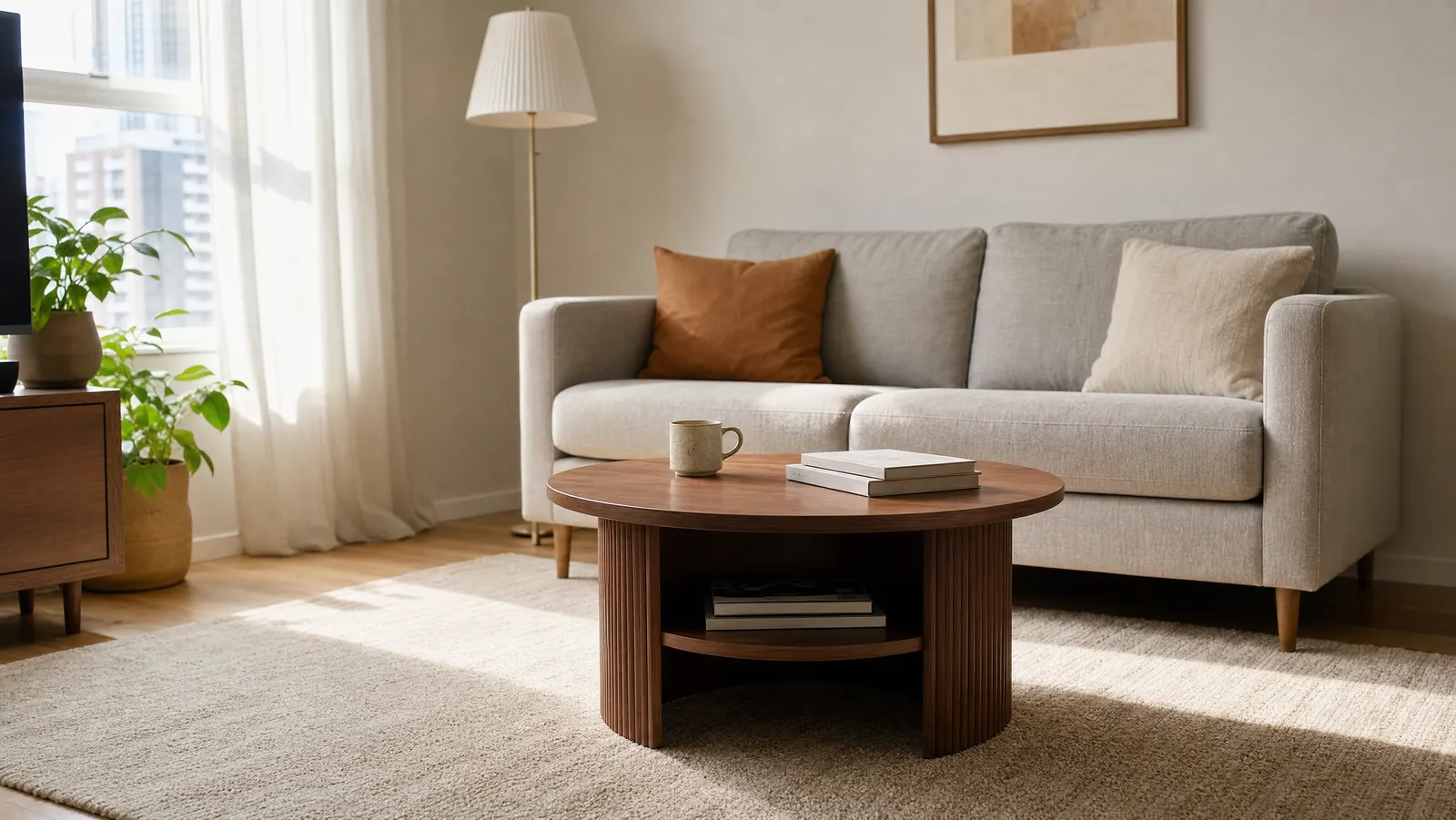
Round. The three-zone split does not apply. Style the centre as one grouping and leave the outer arc bare — the far edge is out of reach from the sofa. Three objects, done.
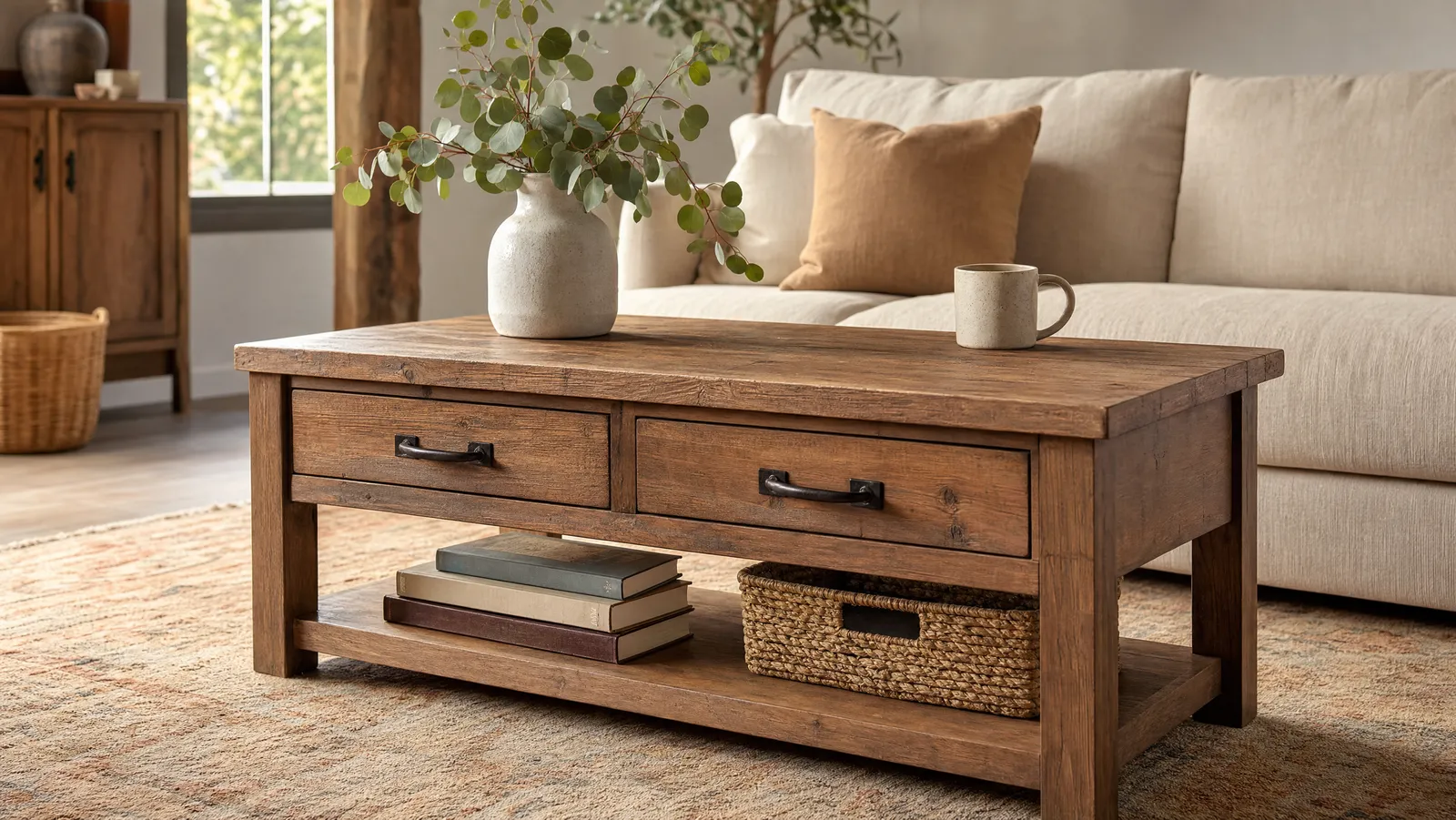
Rectangular. The three-zone approach in its natural habitat: tray at one end, books in the middle, living thing at the other, front strip clear.
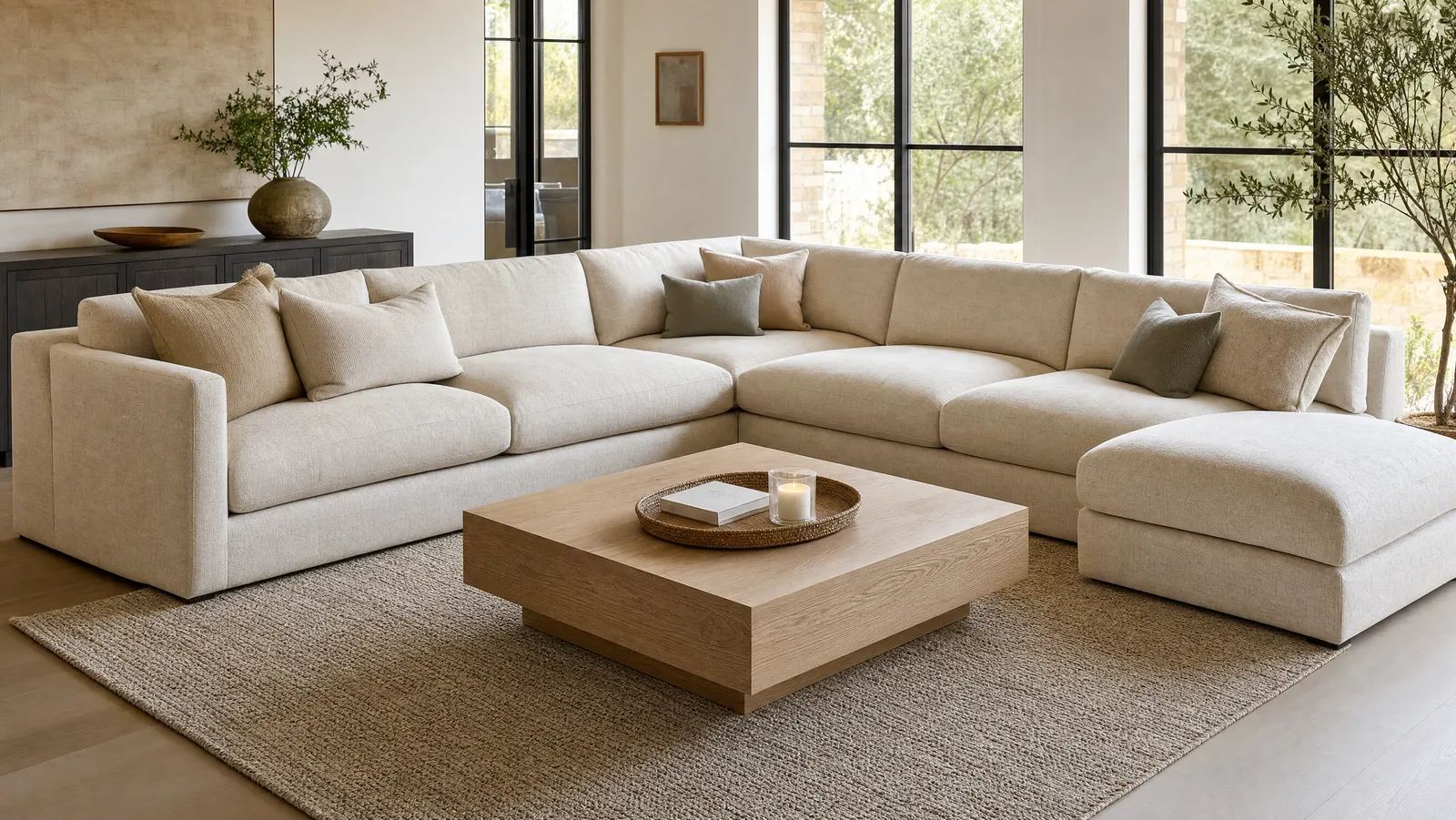
Square. Work on the diagonal — two groupings on opposite corners, the other two open, avoiding the bullseye a centred arrangement gives a square top.
Oval. Like a rectangle, but keep objects off the narrowing ends where they read as stranded.
The trade-offs each shape makes in a real room are in our coffee table shapes guide.
Styling by Material
Glass shows everything. Povison's guide to stone and sintered coffee tables notes that glass resists staining well but needs frequent cleaning to look clear. It also shows the undersides of your objects: use a tray with a solid base and felt-pad anything ceramic.
Wood forgives. It hides dust and takes a scratch as patina. Its weakness is moisture and heat: the National Park Service's curatorial guidance on wooden objects notes that the resin finishes common on furniture are susceptible to damage from water and alcohol, and that a surface left in the sun or beside a radiator dries unevenly and can cup. So: coasters under cold drinks, a cloth under anything hot, no wet vase left overnight.
Stone needs coasters, not opinions. The same Povison guide notes that marble's pores make it prone to etching from coffee, wine and citrus if it is not sealed, recommends sealing marble, travertine and limestone on your fabricator's schedule, and warns that marble can be etched by very hot items or repeated thermal shock. Here a coaster is a requirement, not good manners. How each surface behaves over a decade is the subject of our comparison of coffee table materials.
Styling a Big Table vs a Tiny One
Big tables, 54 inches and up. The instinct is to add objects. Resist it and scale the objects up instead: bigger tray, taller vase, wider bowl. Three groupings is still the number, just further apart.
Small tables, under 36 inches. One tray, two books, one small vessel. On a 30-inch round we skip the tray, because a tray plus a stack plus a plant leaves no landing zone.
Nesting or paired tables. Style the larger, leave the smaller bare — the empty one is the surface that gets used.
Scale reads against what is under the table too — our guide to stylish rugs for the living room covers the sizes that let a sofa and coffee table share one rug.
Households With Kids or Pets: What to Take Off
The arrangement above assumes adults. Here is the subtraction list.
- Lit candles. The U.S. Fire Administration's candle safety guidance says to keep candles at least 12 inches from anything that burns, and reports an average of 20 home candle fires a day. A styled table is paper, fabric and dry stems at exactly the height a tail or an elbow sweeps. The same guidance recommends flameless candles, which is what we use here.
- Toxic plants and cut lilies. See the ASPCA list above. With a cat, not a preference.
- Glass, thin ceramics and narrow bases. Wide-bottomed wood or resin survives a bump. A bud vase does not.
- Small hard objects. Decorative spheres, stones, agate coasters — small enough for a toddler to put in a mouth, and easy to throw.
- Reed diffusers. They tip easily, and the oil can damage a finish.
What stays: a rigid tray with a lip, two books, a wooden bowl, a wide low planter. Still styled, with much less on it that a three-year-old can turn into a problem.
Seasonal Swaps Without Buying More Stuff
You do not need a seasonal kit. The arrangement has one variable slot: the living thing. Autumn gets bare branches, dried grasses or a bowl of walnuts. Winter gets evergreen clippings and a heavier textile under the tray. Spring gets a single stem, or three, in a low vase. Summer gets fruit in the bowl you already own.
The one rule: swap, do not add. The tray, the books and the empty half stay constant all year. If a seasonal object goes on, a permanent one comes off — otherwise December ends with eleven things on a table built for five.
What We Would Never Put on a Coffee Table
- Anything you must move before the table works. A centred pedestal bowl is the usual culprit.
- Framed photographs. They get knocked flat, face one direction, and a shelf does it better.
- An obviously fake plant. A bad faux stem reads as fake from ten feet. A good one, in a real pot with soil on top, does not.
- A second tray. One frame per surface. Two make the top look like a filing system.
The Ten-Minute Version
Clear the table. Put down a tray about two-thirds its length and build one group of three inside it at mixed heights. Stack two or three books flat elsewhere, biggest on the bottom, one small object on top. Add one living thing. Then check that a laptop still fits without moving anything; if it does not, take one object away.
Leave it a week and watch what the household does to it. Whatever keeps getting moved is in the wrong place, and the empty half will prove the most useful part of the arrangement. If the exercise convinces you the table itself is the problem — too small, too tall, wrong shape for how you live — that is a legitimate conclusion, and Voguish Home Design's coffee table guide is where to start over.
The Author
About the author
Interior Designer
Donald Martin
Designer since 2006 and a lifelong lover of rescued objects, Donald Martin knows how to give a second life to pieces and weave them into an eclectic, personalized interior. He writes about decorating real homes on a real budget.