Floor Lamps · 13 min read
Floor Lamp vs Table Lamp: Which One Does Your Room Need?
 Donald Martin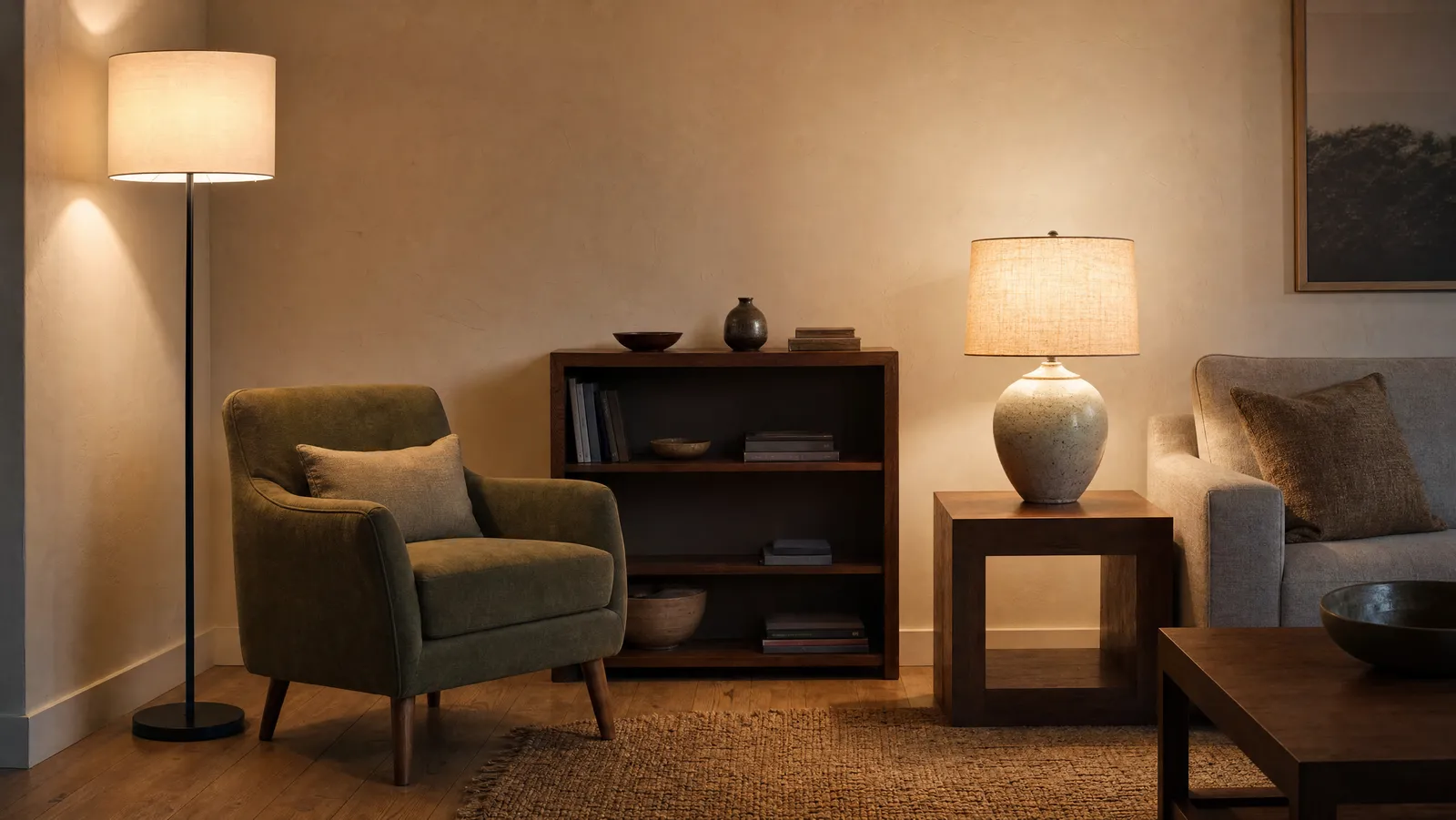
Floor lamp vs table lamp comes down to one question: does the seat already have a surface? No side table, or a table already full, means a floor lamp. An existing end table or nightstand within arm's reach means a table lamp, which usually costs less and hides its cord better. If the whole room is under-lit, the floor lamp wins.
That is the short version, and for most rooms it is the whole answer. The longer version is a trade: a floor lamp spends floor space to free your tabletops, a table lamp spends tabletop to keep your floor clear. Once you have settled which side of that trade you are on, our main guide to how to choose a floor lamp handles the rest of the decision - height, bulb, shade and base.
The Short Answer: Do You Need a Floor Lamp or a Table Lamp?
Buy a floor lamp when:
- There is no side table next to the seat, and you do not want to buy one. A floor lamp arrives with its own support.
- The table you have is already full. A book, a drink, a remote, a charging phone and a lamp base do not all fit on a 16-inch-wide end table.
- The room is genuinely dark. A floor lamp can throw light at the ceiling and spread it across the room. A table lamp cannot reach the ceiling from 28 inches up.
- The lamp has to move. Rentals, rooms you rearrange, and seats that migrate favor a single plug-and-go piece.
Buy a table lamp when:
- There is already an end table, console, or nightstand inside arm's reach of where you sit.
- You want the light low and close - a pool over one chair rather than a wash across the room.
- Floor space is the scarce thing. A tight bedroom, a corner that already holds a plant, a walkway you do not want to narrow.
- Budget is tight. In our shopping, a table lamp generally costs less than a floor lamp of comparable quality - the floor lamp needs a tall pole and a weighted base.
If both lists fit your room, the tie-breaker is the surface: count the free space on the table beside the seat. Under about a foot square, a table lamp will annoy you daily.
Floor Lamp vs Table Lamp Brightness: Light Output and Spread
Most comparisons get this wrong. A floor lamp is not inherently brighter than a table lamp - brightness belongs to the bulb, not the category. Put the same 800-lumen LED in both and both emit 800 lumens. What changes is where those lumens land.
You need less output than you think for the task itself. According to BenQ's lighting knowledge center, roughly 450 to 500 lumens is enough for reading, writing, or general work, while intricate tasks may call for 800 to 1,100 lumens. According to the U.S. Department of Energy's Federal Energy Management Program guidance on energy-efficient light bulbs, producing 800 lumens takes a 60-watt incandescent but only 5.9 to 10.5 watts from an LED. The DOE also announced in April 2024 that efficiency standards for the most common bulbs will rise from 45 lumens per watt to more than 120 lumens per watt, with manufacturer compliance required by July 25, 2028.
Spread is the real difference:
- A floor lamp lights an area. Its shade sits four to five feet up, so the cone of light it drops covers more floor than a table lamp's does. A torchiere aims the whole output at the ceiling and lets the room bounce it back, which is why a single floor lamp can stand in for a missing ceiling fixture. If you are weighing which shape does which job, we broke down the differences between torchiere, arc, tripod and task lamps separately.
- A table lamp lights a seat. Its shade rises only as high as the table plus the lamp, so the pool it throws stays tight. That is a feature when you want one chair lit and the rest of the room dim, and a problem when you were hoping to light the room.
The brightness verdict: for reading, either lamp does it with the same bulb. For making a dark room usable, only the floor lamp does.
Floor Space vs Surface Space: The Real Trade-Off
A floor lamp's footprint looks small - on the lamps we look at, most bases are under a foot across - but it lands in the room's traffic, not on a table. In a narrow living room that is the difference between walking past the sofa and shuffling past it.
A table lamp has no footprint at all, as long as you already own the table. If you do not, price the pair honestly: a side table plus a lamp is usually more money and more square footage than one floor lamp. That is the most common reason we would put a floor lamp beside a chair - geometry, not light.
The trade usually resolves cleanly. Dead floor at the end of a sofa or behind a chair is free real estate for a floor lamp. A nightstand that exists anyway, next to a floor that is a walkway, is free real estate for a table lamp. Before you commit either way, read up on where a floor lamp should sit relative to the seat - a lamp in the wrong spot is wasted no matter which type you bought.
Height and Glare: Where the Shade Bottom Has to Land
Both lamps are aiming at the same target, and the target is your eyes. According to Star Furniture's lamp size guide, floor lamps tend to range from 58 to 64 inches tall, and a table lamp should sit at about eye level when you are seated near it, which it also puts at about 58 to 64 inches from the floor. Same number, two routes to it. Star Furniture adds that a lamp next to a couch on a 28-inch-tall table typically measures about 30 inches from base to the top of the shade.
The rule behind the number is simple: if the bottom edge of the shade lands below your seated eye line, you see the bare bulb and the lamp glares. Above it, you see lit paper instead of the source.
A table lamp rarely glares because the math is nearly automatic. Star Furniture's 28-inch table and 30-inch lamp put the top of the shade at 58 inches and the shade opening just below it, which is about where a seated eye line falls.
A floor lamp glares more often for two reasons:
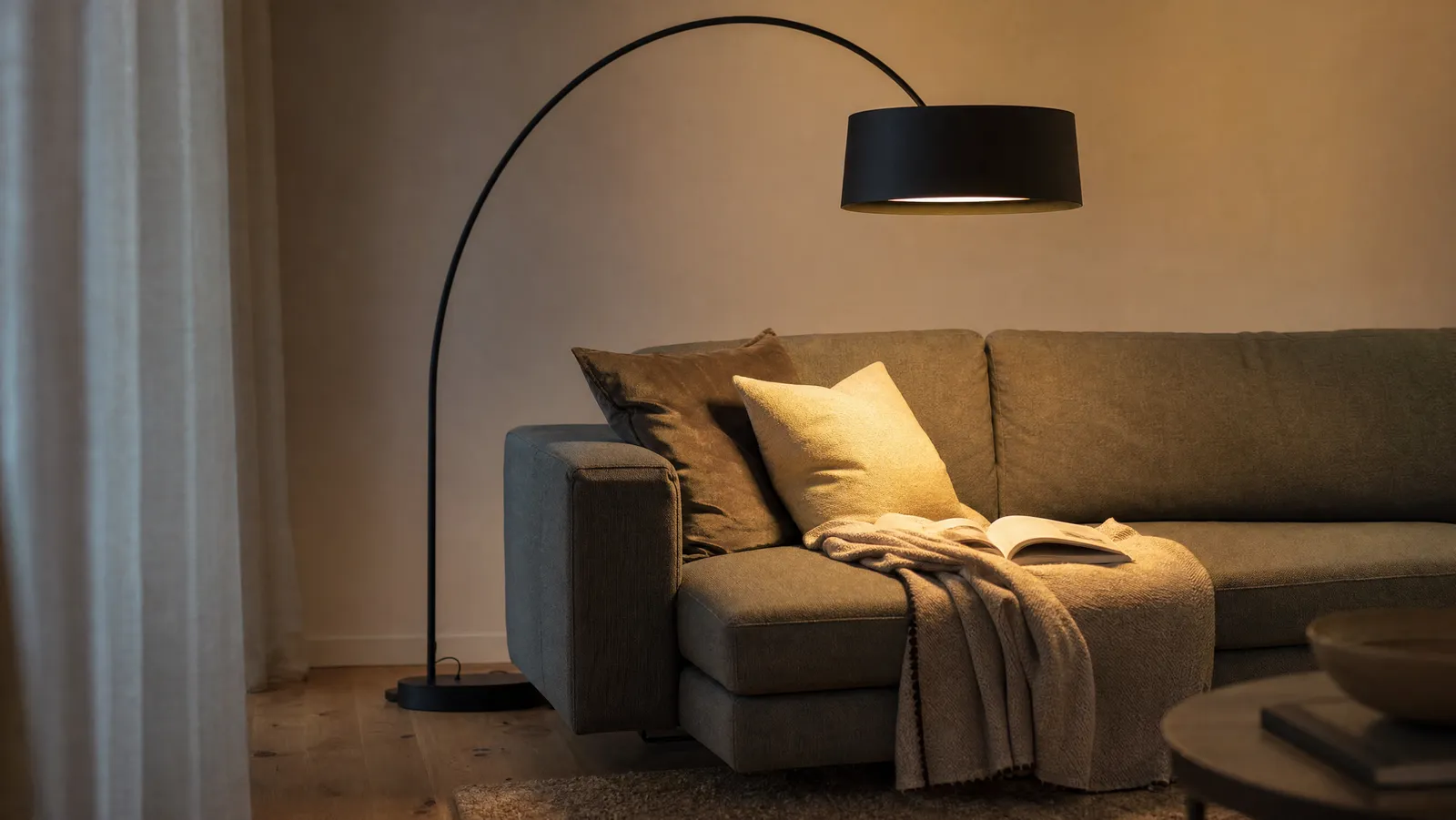
- The shade can hang lower than you expect. An arc lamp suspends its head over the sofa, sometimes well under 58 inches, putting the aperture in the eye line of anyone beneath it.
- Task heads tilt. A swing-arm or pharmacy head aimed at a book is also aimed at whoever sits across from it. Rotate the head, do not just raise it.
The fix is cheap: set the lamp slightly behind the shoulder line of the seat rather than beside it, so the shade opening falls outside your field of view.
Cost, Cords, and Flexibility
Cords. A table lamp drops its cord behind the table and down a leg, out of sight. A floor lamp runs its cord along the floor to the nearest outlet, and if the only outlet is behind the sofa you will see that cord every day. Measure the run before you buy.
Safety listing. According to UL, UL 153 is the Standard for Safety for Portable Electric Luminaires, covering movable fixtures connected by a flexible cord and attachment plug - floor lamps, desk lamps, and task lights among them. UL says the evaluation assesses the risks of fire, electric shock injury, contact burns, and mechanical injury from instability or a failure of the mounting means. Mechanical stability is the clause that matters more for floor lamps, since they are the ones a toddler or a dog can tip. Look for a UL or ETL listing mark either way.
Flexibility and controls. A floor lamp relocates in one trip; a table lamp relocates only if its table does too. Both accept a dimmable LED, but in our shopping, integrated dimmers, three-way sockets, and foot switches turn up more often on floor lamps, while table lamps more often hide a socket switch under the shade. Check the control before the finish.
Using a Floor Lamp Instead of a Table Lamp, and When to Use Both
Swapping a floor lamp in for a table lamp is the right call when the table is the problem: too small, too cluttered, too low, or not there. It is the wrong call when the seat needs light somewhere the floor cannot reach - a bed flanked by walls, a window seat with no floor beside it.
Most well-lit rooms are not an either-or. They run both, doing different jobs: the floor lamp supplies general and task light, the table lamp supplies the low, decorative pool that makes a room look furnished after dark. According to the Lighting Design Store, accent lighting should be at least three times brighter than a room's ambient light to register as a focal point - a useful way to think about the small lamp. It is not there to add lumens, it is there to make a bright spot.
Two rules when you run both. Do not put them side by side - two lamps within a few feet of each other tend to produce one bright corner and one dark room, so take opposite ends of the seating. And match the color temperature, not the shade: mixing a warm bulb with a cool one reads as a mistake faster than mixing lamp styles does.
Room by Room: Table Lamp or Floor Lamp in the Living Room, Bedroom, and Beyond
Living room
Run both if the room allows it: a floor lamp at the far end of the sofa or behind the reading chair, where there is no table, and a table lamp on whatever end table already exists. If you only buy one, buy the floor lamp - it is the only one of the two that can light the room rather than just the seat.
Bedroom
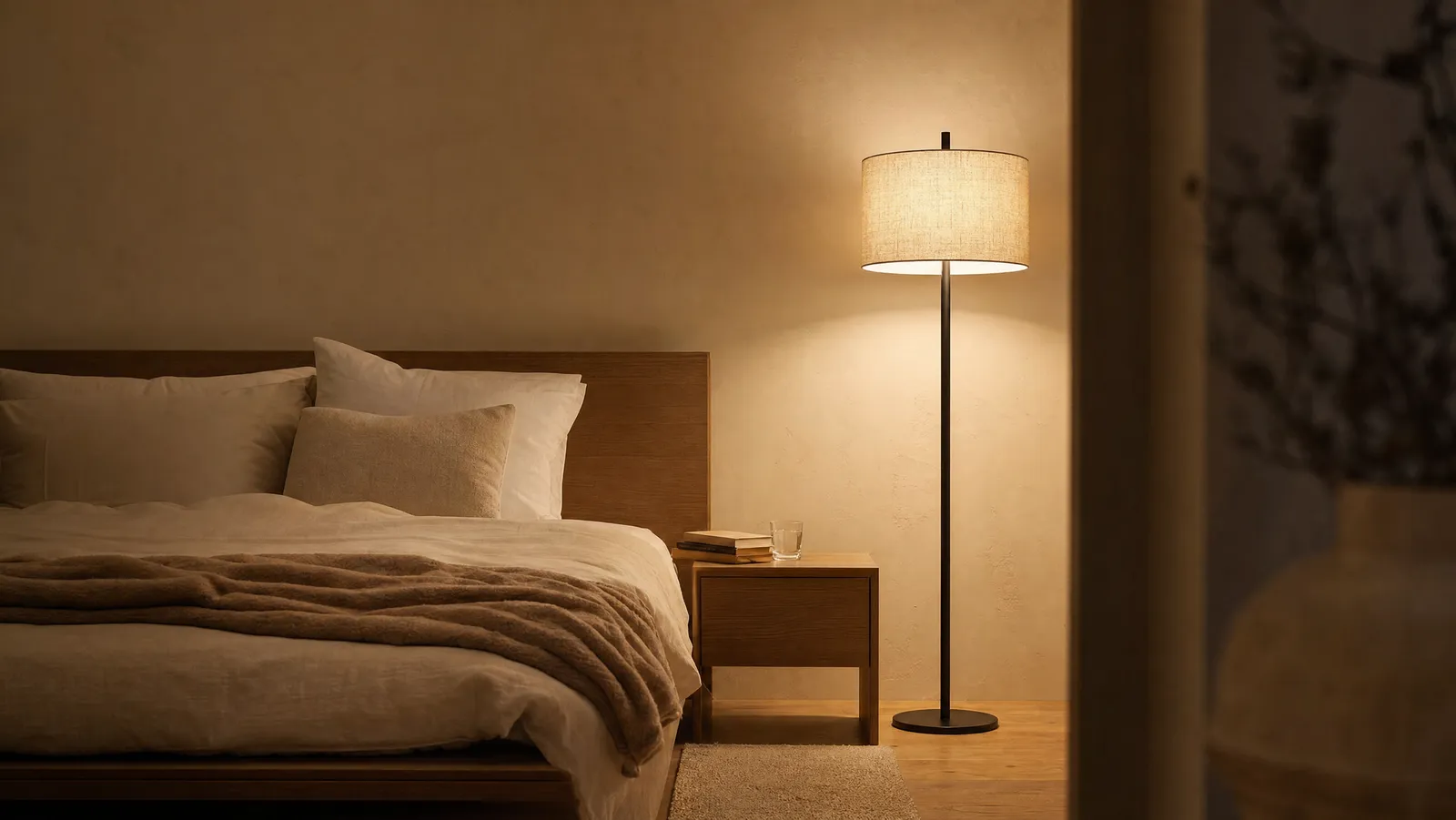
The nightstand usually settles it, and the table lamp wins by default. The exception is the bedroom where the nightstand is 12 inches wide and already holds a glass of water, a book, and a phone - there, a slim floor lamp beside the headboard frees the whole surface. Either way, the control needs to be reachable from the pillow, which is why we put the dimmable lamps we would stand beside a bed in their own guide.
Keep the evening setting warm and low. According to Harvard Health, light of any kind suppresses melatonin, and in one Harvard experiment 6.5 hours of blue light suppressed melatonin for about twice as long as green light of comparable brightness and shifted circadian rhythms by twice as much, 3 hours versus 1.5. Harvard Health also notes that as little as 8 lux has an effect - a level most table lamps exceed. None of that means a lamp will fix anyone's sleep, but it is a fair argument for a dimmer and a warm bulb next to a bed. According to Waveform Lighting, 3000K reads as a slightly more neutral, crisper white than 2700K, so if you want the golden, candle-like register for the last hour of the day, 2700K is the warmer of the two.
Reading corner
A floor lamp, almost always. A reading chair rarely has a table of the right height beside it, and the adjustable head on a task or pharmacy floor lamp puts light on the page from behind your shoulder, where it is less likely to glare. Aim for the 450 to 500 lumens BenQ cites, not the brightest bulb the socket accepts.
Small apartment or rental
A floor lamp. It needs no second purchase, and it can stand in for the overhead light a rental usually lacks by bouncing output off the ceiling. One torchiere in the corner plus one task lamp at the chair covers a studio better than three table lamps that each need a surface.
Frequently Asked Questions
Is a floor lamp brighter than a table lamp?
Not by itself. Both emit whatever the bulb emits, so an 800-lumen LED gives 800 lumens in either one. A floor lamp makes a room feel brighter because it spreads that light over more area from a higher position, and because more of them aim output at the ceiling.
Can a floor lamp replace a ceiling light?
In a small or medium room, often yes, which is why they are standard in rentals with no overhead fixture. A torchiere comes closest, because the ceiling acts as a diffuser and sends soft light back across the room. In a large or dark room, plan on two lamps rather than one.
Do I need both a floor lamp and a table lamp in the same room?
In a living room, usually yes - they do different jobs, one lighting the room and one lighting a spot. In a bedroom or a home office, one of each is often one too many. Start with the seat you actually use, then add the second lamp only if the room still has a dark half.
Can I put a floor lamp next to a nightstand?
Yes, and it is a good move when the nightstand is small. Stand it behind or beside the headboard rather than in the walkway, keep the shade bottom above your eye level when you are sitting up in bed, and make sure the switch is within reach from the mattress.
What height should each one be?
Aim for a shade at seated eye level either way. Star Furniture's guide puts that at roughly 58 to 64 inches from the floor: a floor lamp of 58 to 64 inches, or, on a 28-inch table, a lamp of about 30 inches from base to shade top.
The Verdict
Stop comparing the lamps and look at the seat. If it has a usable surface beside it, buy a table lamp, put the shade bottom at your seated eye level, and spend the savings on a better shade. If it has no surface, or the room itself is dark, buy a floor lamp - it is the only one of the two that solves both problems at once.
The one case where we would always take the floor lamp: a room with no ceiling fixture. Nothing else at the price turns a dim room into a usable one. From there, picking a floor lamp comes down to height, shade, and whether you want the light aimed up, down, or both.
The Author
About the author
Interior Designer
Donald Martin
Designer since 2006 and a lifelong lover of rescued objects, Donald Martin knows how to give a second life to pieces and weave them into an eclectic, personalized interior. He writes about decorating real homes on a real budget.