Floor Lamps · 13 min read
Arc Floor Lamps Over a Sofa: Reach, Clearance and Base Weight
 Donald Martin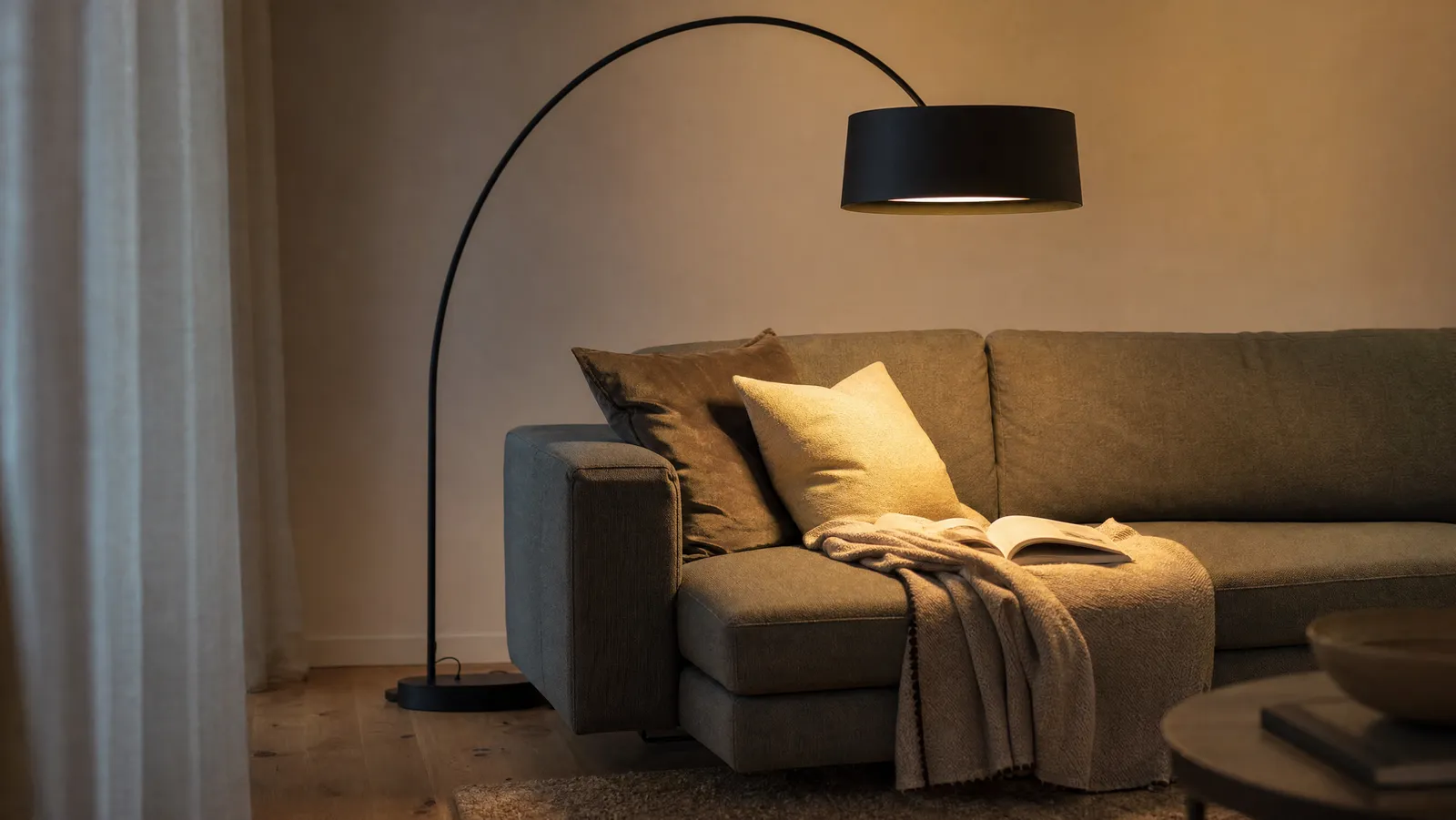
An arc floor lamp over a couch needs an arm that carries the shade roughly 24 to 36 inches out over the sofa back, a base parked 6 to 12 inches behind the sofa, and a shade hovering 30 to 36 inches above the seat cushion. Hit those three numbers and the lamp reads like a pendant you never had to wire. Miss them and you own a very heavy coat hook.
The catch is that none of those numbers is printed on the box. Listings publish height and a shipping footprint, so shoppers assume a tall arc reaches far. It does not. Below is the geometry, the clearance, the base weight, and the one measurement worth hunting for before you buy. For the wider decision - bulb, switch, shade, scale - start with our guide to choosing a floor lamp.
How Far an Arc Floor Lamp Actually Reaches
Less far than its height suggests. An arc lamp is a pole plus a curve, and the curve spends most of its length climbing rather than traveling. Some lamps that stand nearly 80 inches tall move the shade only about 20 inches sideways from the pole. That is why "how far does an arc lamp reach" is the question that saves you a return shipment.
Two different numbers get sold to you as reach:
- Total span is what the width or depth figure in a listing usually describes: the widest point of the assembled lamp, base edge to shade edge. It tells you whether the lamp fits through a doorway. It does not tell you where the light lands.
- Usable overhang is the horizontal distance from the center of the pole to the center of the shade. This is the number that decides whether light reaches your book.
Usable overhang is always the smaller of the two. When a listing gives dimensions as length by width by height, the length or depth figure is your best proxy. Makers are inconsistent about whether that number is measured from the pole or from the base edge, so treat it as an estimate and ask the seller which it is.
Then do the sofa math. According to Ashdeco's placement guide for a floor lamp behind a couch, the lamp base goes 6 to 12 inches behind the couch back, and an arc arm should carry the shade 24 to 36 inches out over that back. Castlery's sofa size guide puts standard sofa depth at 33 to 37 inches, and seating depth on a standard sofa is commonly quoted at 21 to 24 inches, which puts the middle of the seat roughly 22 to 25 inches in from the back of the sofa. Add the setback to that and you need somewhere between the high 20s and high 30s of overhang, measured from the pole, to put light where a shoulder actually is.
That is the whole arc lamp problem in one line: some arcs reach only about 20 inches from the pole, and a sofa asks for close to 30. If you want the sculptural look without the stretch, it is worth comparing the other floor lamp shapes and where each one throws light before you commit to a curve.
Clearance Over a Sofa: Three Numbers That Have to Agree
Reach is only the horizontal half. An arched floor lamp in a living room is doing a pendant's job without a pendant's junction box, so it also has to clear heads, clear traffic, and stay out of the coffee table's airspace.
Above the cushion. Ashdeco's behind-the-couch guide puts the shade 30 to 36 inches above the seat cushion. Standard sofa seat height is usually quoted at about 17 to 19 inches, so that lands the shade roughly 47 to 55 inches off the floor. Ashdeco's floor lamp height guide puts seated eye level at 40 to 44 inches for adults between 5 feet 4 and 5 feet 10, so a correctly hung arc shade sits several inches above the sight line of anyone sitting upright. Slouch or lie down and you are looking straight into it.
Behind the back. The 6 to 12 inches of setback has to come from somewhere. If the sofa is against a wall, the sofa hides the base and the math is free. If the sofa floats in the room, that setback competes with your walkway: VBU Furniture's living room walkway guide treats 36 inches as the standard for primary circulation paths and 30 inches as a tight-room minimum. Stack the two and the sofa needs to sit roughly 36 to 48 inches off the wall, which a lot of rooms simply cannot give up.
In front of the seat. According to Vinson Fine Furniture, the standard gap between a sofa and a coffee table is about 18 inches, with 16 to 20 inches the comfortable range and 12 to 14 inches the fallback in compact rooms where traffic flow wins. Keep the shade behind the front edge of the seat cushion. Push it further and you light the coffee table, shine into the face of whoever sits opposite, and invite someone to stand up into the shade reaching for a mug.
If you are still deciding where the lamp goes at all, our room-by-room rules for where to put a floor lamp cover the beside-the-sofa and behind-the-sectional options too.
Base Weight and Why Arc Lamps Tip
An arc lamp is a cantilever. The shade, socket, bulb and outer third of the arm all hang past the base, and their weight acts through a long lever arm. Doubling the overhang roughly doubles the tipping moment the base has to resist. That is why arc lamps ship with slabs of marble or filled steel discs.
What to look for, in order:
- A listed lamp. UL 153 is the North American safety standard for portable electric luminaires; LISUN's summary of it describes coverage spanning electrical safety, thermal performance, mechanical stability and material flammability. The standard's own Stability Test section sets the luminaire on an inclined plane and requires that it not overturn, with the test angle depending on the type of luminaire. A UL or ETL mark means the design passed that kind of bench test. It does not mean the lamp will survive a toddler hanging off the shade.
- Mass low and wide. Ashdeco's guide suggests a base 12 to 16 inches across for a behind-the-couch arc. We would also want the footprint to extend toward the arc, not just around the pole - a round base that is wide only side to side does nothing for the direction the lamp wants to fall.
- Weight proportional to overhang. No safety standard ties base weight to reach, and what maker guidance exists is scattered and inconsistent. So treat this as our editorial rule of thumb: we would not hang a 30-inch overhang on anything under about 25 to 30 pounds of base, and the longer the arm, the more we would want.
- The two-finger check. Assemble the lamp, then press gently down on the shade rim. If the far edge of the base lifts off the floor, the counterweight is wrong for the reach, and no amount of careful placement fixes it.
Floor surface matters too. On thick carpet, the pile compresses unevenly under a heavy base and lets the pole lean toward the arc, which quietly adds overhang and spends the stability margin you paid for. We would slide a thin, firm board under the base, beneath the rug, for a flat bearing surface.
Then route the cord: down the pole, behind the sofa, to the outlet without crossing a walkway. A cord lying in the traffic lane is the hazard we worry about most here, because the one thing a cantilevered lamp cannot absorb is a sideways yank.
Arc Floor Lamps Over a Sectional: The Chaise Problem
This is where the geometry usually loses. According to Coleman Furniture's sectional dimensions guide, a sectional body runs about 35 to 42 inches deep, but a chaise extension pushes 60 to 72 inches or more. An arc with 24 to 36 inches of usable overhang cannot center itself over a chaise from behind. It will not get close.
Three positions that do work:
- At the foot of the chaise. Stand the base off the open end and let the arc run up the length of the chaise, the way you would light a daybed. Your reach now points along the long axis instead of across it.
- At the outside corner of the L. A base tucked into the back corner can swing the shade diagonally over the corner seat, which is often the most-used seat in the room anyway.
- Behind the straight run. Serve the two upright seats where people actually read, and give the chaise its own light - a table lamp on a side table, or a second floor lamp beside it.
What does not work is reaching over the chaise from the room side. The base ends up in the middle of the floor, in the traffic lane, with nothing hiding it.
Arc Floor Lamp Height and Shade Position
Arc lamps are the one floor lamp category where pole height is not the headline number, but it still has a job: the arm has to climb over the sofa back before it comes down. Castlery puts total sofa height at 30 to 35 inches, and Ashdeco's behind-the-couch guide recommends a total lamp height of 72 to 84 inches for an arc in that position - considerably taller than the 58 to 64 inches a conventional lamp standing beside a sofa wants. For the general rule, and how it changes for chairs and beds, see our guide to how tall a floor lamp should be.
Shade orientation is the other half. Ashdeco recommends a diffusing shade - linen, rattan, or frosted glass - facing downward or outward rather than up toward seated eye level. We agree, and would go further: a bare bulb suspended around 50 inches off the floor glares at everyone who is not sitting perfectly upright. If the shade is open at the bottom, use a frosted or filament-style bulb, not a bright clear globe.
How Much Light an Arc Lamp Has to Put Out
An arc shade sits much higher above a book than a table lamp does, and light obeys the inverse-square law: roughly double the distance and the illuminance on the page falls to about a quarter. An arc lamp needs more output than a table lamp to do the same reading job.
According to Super Bright LEDs' summary of the Illuminating Engineering Society's residential recommendations, a living room wants 10 to 20 foot-candles of ambient light, which is 108 to 215 lux, while difficult reading and writing calls for 50 to 100 foot-candles. The same guide estimates total lumens by multiplying room square footage by target foot-candles. Run that formula on a 400-square-foot room at 10 foot-candles and you get about 4,000 lumens, across every fixture in it.
One arc lamp will not produce that, and should not try. Treat it as the reading light over one or two seats, put it on a dimmer, and let other lamps carry the ambient load.
Mistakes We See
- Shopping on total height. The tallest arc in the search results is often not the one with the longest arm. Find the overhang figure or skip the lamp.
- Parking the shade over the coffee table. It lights the tabletop, glares at the person opposite, and becomes a head-height obstacle the moment someone leans in.
- Putting the base in the traffic lane. An arc base belongs behind furniture or in a corner. In open floor it is both a stubbed toe and a tipping risk.
- Pairing a long arm with a light base. This is the one failure that cannot be designed around after purchase.
- Aiming an open shade upward over seating. An arc lamp is a downlight by design. Let it be one.
- Assuming the shape is dated. Fair question, and not a simple yes or no - we work through which floor lamp styles still look current separately.
Arc Floor Lamp FAQ
How far does an arc floor lamp reach?
Usable overhang is the number that matters, and it is usually much shorter than the lamp is tall. Ashdeco's behind-the-couch guide calls for an arm extending 24 to 36 inches past the sofa back, with the base set 6 to 12 inches behind it. Measure your own sofa before trusting a product photo.
How heavy should an arc lamp base be?
No safety standard ties base weight to reach. Our working rule is 25 to 30 pounds minimum for a 30-inch overhang, more as the arm gets longer, with the weight low and the footprint extended toward the arc. A UL or ETL listing confirms the lamp passed a stability test, which is a floor rather than a guarantee.
Can an arc floor lamp replace a ceiling light?
For one seating zone, often yes - that is the whole appeal in a rental with no overhead fixture. For a whole room, no. The 10 to 20 foot-candle living room target summarized by Super Bright LEDs generally needs several sources spread around the space, not one shade in one spot.
Do arc floor lamps work over a sectional?
Over the straight run, yes. Over a chaise, usually not from behind, because a chaise extension of 60 to 72 inches or more, per Coleman Furniture, is longer than any common arc reaches. Set the base at the foot of the chaise and light along it instead.
Will an arc floor lamp tip over?
It can. The usual causes are a yanked cord, soft carpet letting the pole lean, or a base too light for the arm. A listed lamp on a firm surface, cord routed behind the sofa and base set so its mass opposes the arc, is a stable object. Break any of those and we would not put it next to a crawling baby.
The Bottom Line
Arc lamps are the only floor lamp that can put light in the middle of a sofa without a ceiling junction box, which is worth a lot in a room with no overhead fixture. They just ask you to shop on a number nobody advertises. Find the usable overhang, check it against your sofa depth, demand 30 to 36 inches of shade height above the cushion, and make sure the base is heavy and wide enough to argue with the arm.
If this is your first lamp for the room rather than your third, work the broader decision first: our guide to how to choose a floor lamp covers brightness, color temperature, switches and scale, and it will tell you quickly whether an arc is the shape your sofa actually needs.
The Author
About the author
Interior Designer
Donald Martin
Designer since 2006 and a lifelong lover of rescued objects, Donald Martin knows how to give a second life to pieces and weave them into an eclectic, personalized interior. He writes about decorating real homes on a real budget.